Additional FTP Accounts in cPanel


In essence, FTP represents “File Transfer Protocol”. File transfer protocol is managing the files related to your website. cPanel has an FTP server that is user-friendly and pre-configured already. If you own a website, your FTP access must be configured previously. You can quickly log in through FTP using your cPanel account username & password.

Also, you can systemize FTP accounts for supplementary users. Initially, you have to create a user’s account. After that, a particular user can log into your website with the help of an FTP client like Cyberduck or FileZilla. For instance, if a user attempts to log into the FTP website using a client/customer, he/she has to format the username like username@instance.com, where “instance.com” symbolizes the domain name. If you provide the login information in this fashion, your server can possess numerous FTP accounts across several websites.

How to Create Additional FTP Accounts in cPanel

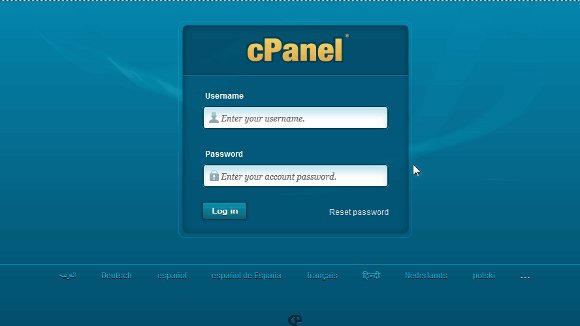
To log in to your cPanel account, just enter the website ‘URL’ and add “/cpanel” at the end of the ‘URL’. Now, you will be taken to the login screen. Here, enter your web hosting username & password to access your cPanel.

The demonstration given below assumes that the user has already logged in to the cPanel and is ready to discover how to set up additional FTP accounts.

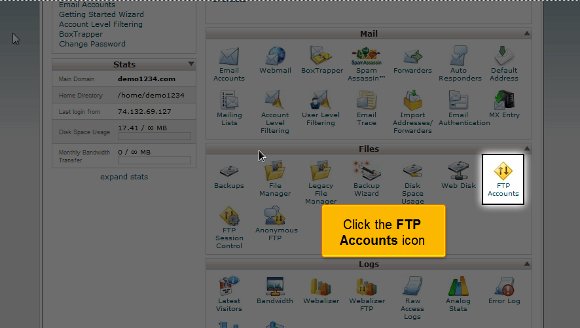
1) Once you are inside the cPanel home page, click on the FTP accounts icon that can be found under the Files section. This is the place where one can manage their FTP accounts. You will be taken to the FTP accounts page. FTP accounts let you access your website’s files through a protocol.
ftp-01

2) enter a unique login ID in the Login space to generate a new FTP account.

ftp-04

3) Now, enter a password and confirm a password one more time for the new account. Make sure that you use a secure password. A secure password should not possess dictionary words and should only contain numbers, symbols and letters. Also, remember that the passwords should have a minimum of 5 characters.

ftp-05

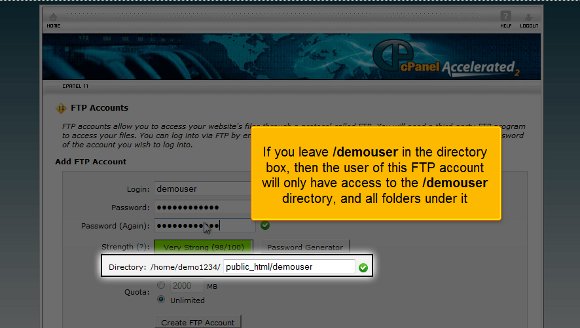
4) Indicate the FTP account’s home directory. The Directory field describes the peak level of your directory access that shall be fixed to your new FTP account. In the directory box, if you leave “/demouser”, then the user of this FTP account may only possess access to the “/demouser directory” and all the other folders under it. In an attempt to offer access to the user to the entire website, you have to delete all except the forward slash “/”.
ftp-08

5) The Quota field below the Directory field establishes the disk space allocated to the FTP account. You may also provide a specific quota limit on this FTP account if needed.

ftp-09

6) When you are ready, click the “Create FTP Account” button at the bottom of the page.

ftp-10

Voila! You have created a new FTP account in cPanel now. From this point, you can modify the password of your FTP account, adjust the quota level, or completely delete an account overall. So, now you know how to generate extra FTP accounts in cPanel from this tutorial.

Password Protect a directory in cPanel


Password Protect a directory in cPanel.

Password-protecting a directory limits the right of entry to specific components of your website by compelling incoming visitors to enter a valid username and a password. This password process is also known as an “Authentication” procedure.

When using this feature, steer through the directories by clicking the folder icon adjacent to the directory name. By clicking the name guide, you will choose the guide for password protection. In the same way, any other subdirectories that are inside the selected directory will also be Password-protected by this process.

Steps to Password protect a directory in cPanel.

To log in to your cPanel account, just enter the website ‘URL’ and add “/cpanel” at the end of the ‘URL’. Now, you will be taken to the login screen. Here, enter your web hosting username & password to access your cPanel.

The demo here assumes that the user has already logged in to his cPanel. So, let’s move on to Password-protecting a directory, as visitors require passwords to view web pages inside.

1) Once inside the cPanel, scroll down the page to spot the “Password Protect Directories” icon under the Security section. Click on the “Password Protect Directories” icon. A dialogue box for “Directory Selection” appears.

Password Protect a directory in cPanel

2) Pick the directory with which you want to begin and click the ‘Go’ button. Now, you will be taken to the “Password Protect Directories”.

protect-02

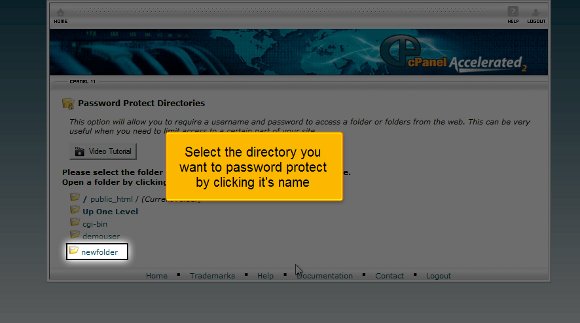
3) Choose the directory you wish to password-protect by clicking the name of it. In our case, we are choosing the “newfolder” directory. You will be taken to the section that’s titled “Security Settings”.

protect-03

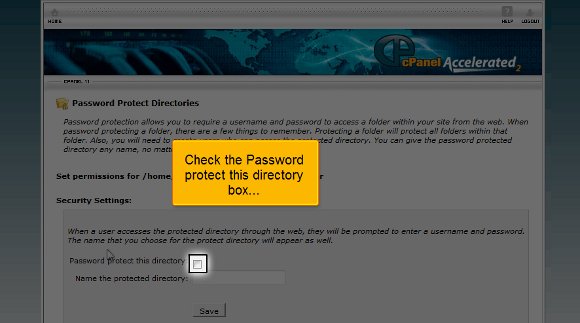
4) Now, check the 1st check box titled “Password protect this directory”. Now, go to the “Name the protected directory” entry box and enter a name for the directory. In our case, the name “newfolder” is entered. This is the name all visitors will notice. The term can appear as anything, regardless of the directory’s name.

protect-04

5) Click the ‘Save’ button. The directory is protected; a password is needed to enter it through a browser.

protect-05

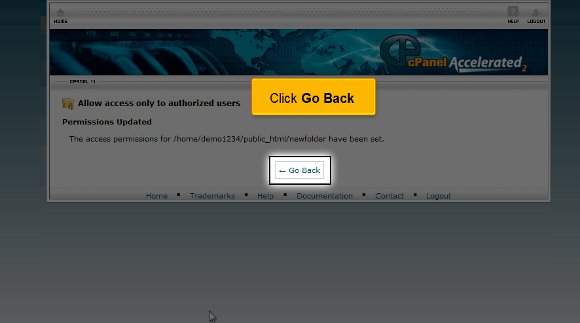
6) Since a confirmation page follows this, Click the “Go Back” button whenever you are ready. We should generate one or more users and allocate passwords to access the directory. Obviously, all users can use the same username & password. However, you may add additional users, which you can do whenever possible.

protect-07

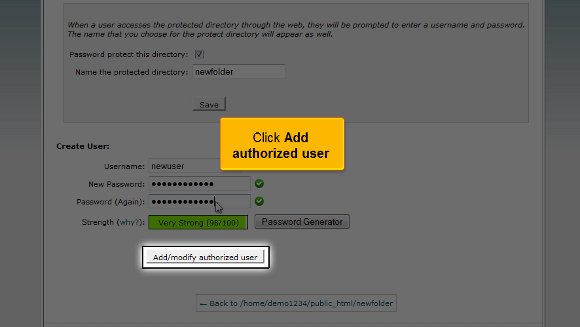
7) Now, scroll down to the section that’s named “Create User”. In the Create User section, enter your visitors’ username to access the directory contents. In our case, the username is given as “newuser”. This new user’s name will be added to the list box under the heading “Authorized Users”, where it can be taken away later on.

protect-08

8) After that, enter the new PPassword in the space given and confirm the new PPassword once more. Pay heed to the password strength meter and always attempt to achieve a Very Strong result.

protect-09

9) Click the ‘Add/modify authorized user’ button to add the username & password. Now, the protected directory has 1 user who has access to it. A confirmation page follows, finely pointing to the username & Password you just added. Repeat the same process for all the other users you wish to grant access to.

protect-11
protect-14

10) Click on the “Go back” button now to add more users (if needed). In the PpPassword-protect directories page, you can view the active users for this directory and add or delete users from this page whenever you wish.

protect-07

Okay!! We have reached the end of the tutorial. Now, you know how to password-protect directories and assign users to passwords from this video tutorial.

cPanel Website stats


How to view your cPanel Website stats

If you are a website owner, you surely want to inspect the number of visitors who visit your website hourly, daily, or monthly. For this purpose, cPanel has many built-in statistic information tools. cPanel comes with several ‘in-house’ premeditated tools that present the customers with comprehensive statistics/summaries of the visitors. One can even view detailed statistical data about his/her website, such as total number of hits, exceptional visits, visits per page and much more, on an hourly basis with the help of these built-in tools available in the cPanel account.

Steps to view your cPanel Website stats

To log in to your cPanel account, just enter the website ‘URL’ and add “/cpanel” at the end of the ‘URL’. Now, you will be taken to the login screen. Here, enter your web hosting username & password to access your cPanel.

The demo here assumes that the user has already logged in to his cPanel. So, let’s move on to viewing the website stats.

1) Once inside the cPanel, scroll down the page to spot the “Logs” Section. Click on the “Webalizer” icon under the Logs section. You will be taken to the “Webalizer Stats”. Webalizer is a multifaceted stats program that creates a range of graphs & charts on the subject of site visitors. Webalizer is the most commonly used tool that is comprehensible. Clicking on the “Webalizer” icon will fetch a catalogue of domains available in your cPanel. You may have one or more based on the intricacy of your website.

stats-01 cPanel Website stats

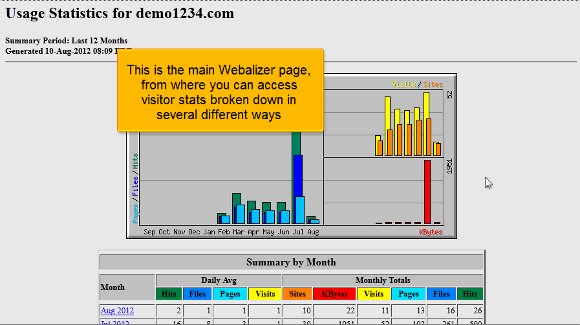
2) After this, select a specific domain and click the Magnifying Glass icon (‘View’ icon) on the right side of the field where you wish to view the stats. Now, you’ll be taken to the chief Webalizer page, where you can access ‘visitor stats’ divided in several ways. The chart given on the top is always color-coded. One can view the bottom chart to understand which colour represents which stat. As a rule, the principal is the “Visits” stat shaded in Yellyellowents, which shows the number of unique visitors visiting your site in a specific month. Hence, one can analyze usage stats for a particular month as well.

stats-02

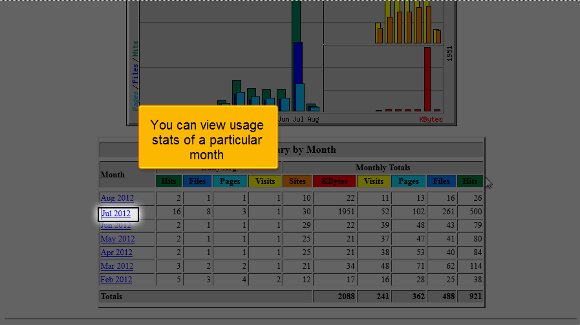
3) On the left of the bottom table, you can find a list of the months for the previous year (2012). Each link will offer you comprehensive stats for that particular month of the year. You can click on a specific month you wish to view in detail. In our case, July 2012 is selected. Now, click the “Hourly Website stats in cPanel” link at the top. Now, you can view the hourly stats for July 2012. You can also use the links at the top to steer through the wide-ranging catalogue of Website stats in cPanel. This wide-ranging list is really drawn out and contains not only statistics for the hits or Website stats in cPanel but also the breakdowns of specific files & pages which has got the majority of hits, details about the pages from which visitors have started and finished and the source of traffic for your website.

stats-03
stats-04
stats-05

4) as an alternative, you can also view the ‘Analog stats’ instead of using the Webalizer. To do so, go to the home page and click on the Analog stats in the Logs section. Now, you will be taken to the Analog Stats page. In essence, Analog is quick and lightweight data that gives a simple summary of all the visitors to your website.

stats-06

5) Click on ‘View’ to see view cPanel Website stats in cPanel sorted month-wise.

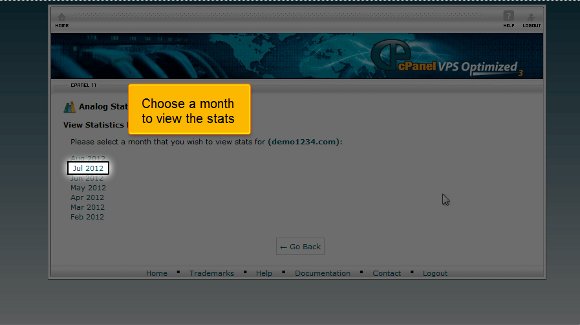
6) Now, select a specific month to view its stats. In our case, July 2012 is set. You will immediately be taken to the “Web Server Statistics” page. One can view the usage stats in several dissimilar ways from here.

Website stats in cPanel
cPanel Website stats

7) Click on the “Daily Summary” button to view the cPanel Website stats summary daily

stats-08

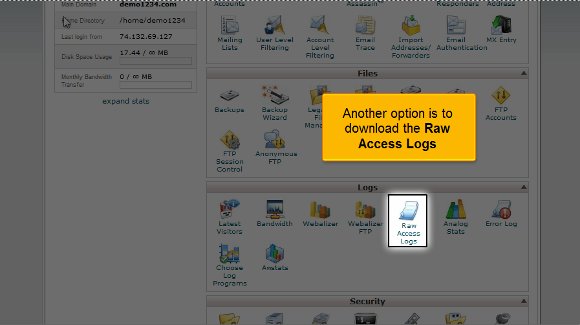
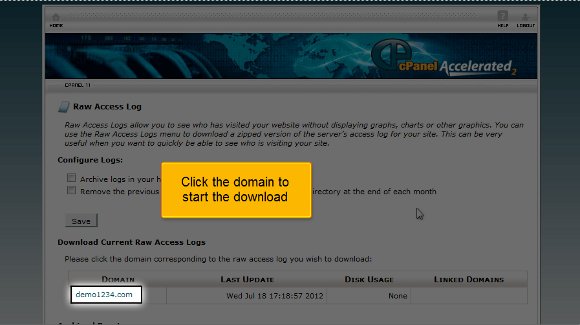
8) Another alternative is to download the “Raw Access Logs”. Go to the home page and click “Raw Access Logs” under the Logs section. Raw Access Logs help you observe the summary of visitors without providing charts, graphs or any other graphics. You can scrutinize the usage data with your personal data analysis application if you download these logs.

stats-09

9) Now, click on the domain to begin the cPanel Website stats download process. A dialogue box will be opened now.

stats-10

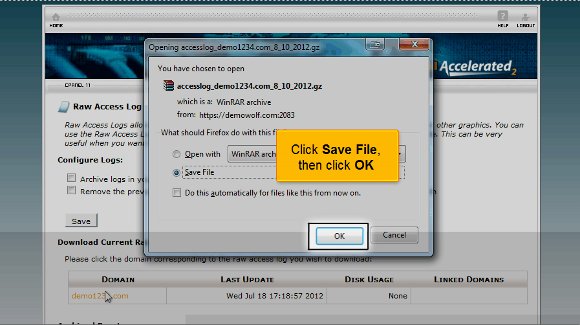
10) Click the “Save File” option and the the “‘OK”‘ button. All done! The cPanel Website states that data has been saved to the computer.

stats-11

We have reached the end of the tutorial at this point. So, you have learned how to access your cPanel Website status and download how to access logs for further study.

Disk Space Usage tool in cPanel


Fundamentally, the cPanel Disk Space Usage tool records all the directories and subdirectories in your home directory. This particular feature showcases how to use your disk space. Also, it can rally around in managing your disk space quota by representing files & directories that utilize vast quantities of hard disk space. In fact, you may be able to click any of the listed directories on your computer to open the related subdirectory in the ”File Manager” feature of cPanel. This tool gives you a detailed outlook of disk usage data about separate files & directories within the subdirectory. However, the Disk Space Usage tool of cPanel will not show the disk usage data for individual files in your home directory.

The Disk Space Usage tool of cPanel also exhibits disk space usage outlines for the following:

  1. Files that are in your home directory
  2. Files that are concealed inside the subdirectories
  3. Mailing catalogs in the Mailman
  4. Files that are not present in your home directory

Owing to the characteristics of storing all of the files electronically, most files take up vaguely more disk space than their original size. For instance, a file of 300 bytes may take up 4 kB of genuine disk space. Consequently, you may discover some inconsistencies between the Disk Space Usage feature and data in the cPanel File Manager element. The Disk space usage data in this feature does not point out the amount of space used by the directory. On the other hand, it just showcases the disk usage data concerning the content. In general, manuals themselves take up an insignificant amount of disk space. Also, note that the figures contained in the Disk Space Usage tool will not reveal any latest modifications that are done in you’reyou’rethe disk space of your account.

Steps to use the cPanel Disk space tool:

The following demo has been presented by considering that the user had already logged in to the cPanel. So, let’s’ move on to how to use the Disk Space Usage tool in cPanel.

1) Click the “”Disk Space Usage”” icon under the Files section. You will be taken to the “”Disk Usage Space”” page, where you can distinguish the amount of storage space (or disk space) that has been used by each directory (folder) & sub-directory in your account. Also, you can find a collapsible list of directories (folders) at the bottom of the “”Disk Usage Space”” page.

disk-usage-00 Disk Space Usage tool

2) Click on a ‘+’ sign of any folder. In our case, the ”+” sign of the ”public_html” directory is clicked. When you click, the directory of ”public_html” will be expanded. Now, you can see all the files & folders inside the ”public_html” directory.

disk-usage-03

3) Now, click on the directory (or folder name). In our case, the ”public_html” is related. You will be taken to the “”File manager”” of cPanel now. The actual contents of ”public_html” will be observed here.

disk-usage-05

4) Also, one can choose to arrange or sort out the directories in the “”Disk Usage Space”” page by specific name or disk usage. In our case, the “”disk usage”” option is selected.

disk-usage-06

Great!! We have arrived at the final stage of this tutorial. Now, you know how to use the cPanel Disk Space Usage tool to distinguish the exact spots where your files have been stored on your computer.

Learn to Use File Manager in cPanel effectively!


How To Use File Manager in cPanel

The File Manager is basically the “en suite” web application of cPanel that’s used for managing and manoeuvring the files on your personal computer. Essentially, the File Manager permits the user to administer his website via “HTTP” more willingly than an ‘FTP’ tool or any other 3rd party application. Using the File Manager in cPanel, one can create or delete files, upload, remove, edit, copy, move, compress/extract files, change file permissions, and organize files in folders. Even though cPanel File Manager is not as refined as most FTP tools, it offers all the essential functionality required to manage your website. File Manager is a speedy and trouble-free way to steer through your files on the website.

For the most part, users feel comfortable using the file manager tool of the cPanel. Generally speaking, cPanel endows numerous ways your files can be manipulated in the File Manager.
Steps to use File Manager in cPanel for various operations

The demo given here has been done by assuming that the user had already logged in to the cPanel. To facilitate login to the cPanel, just type your domain “URL” in your browser window and add “/cPanel” at the end of the URL.

When you log into your cPanel, you will be taken to the home page. On the home page, you can find various sections to perform different unique operations.

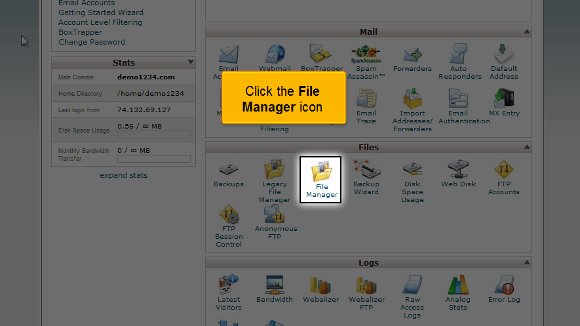
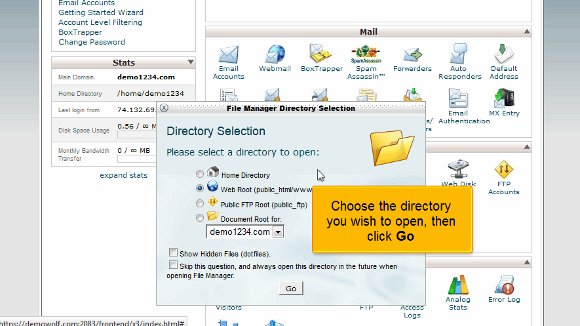
  1. Click the ‘File Manager’ icon under the’ Files’ section. You will be taken to the “Directory Selection” by clicking the file manager icon. Now, you will notice a dialogue box that asks where you wish to log in. To go immediately to your “public_html” folder with your account files, choose “Web Root”.
File manager
cPanel file Manager

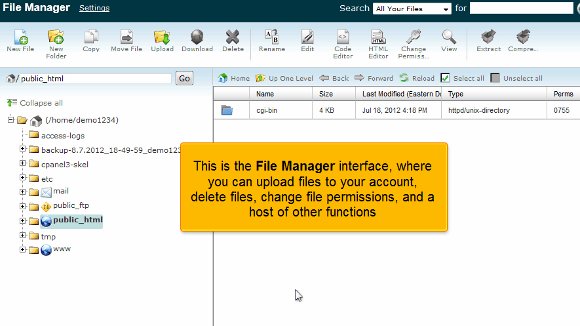
2) Click the ‘Go’ button on the bottom. Now, you will be taken to the ‘File Manager’ interface where you can do several functions such as, upload all the files to your account, change the file permissions, delete files etc. Basically, the left section of the cPanel File manager is the “Directory Listing”. On the left side of the files manager interface, you can find a collapsible listing of all the folders (directories) available in your account. Now, click a folder on the left side. In our case, the ‘public_html’ folder is been clicked.

05-public_html

3) Now, on the right side, you can find a list of all folders & files inside the folder that is chosen on the left side. This right section is basically the “File Listing”. So, your website files (html pages, gif images, etc) should go into the ‘public_html’ folder.

06-public_html-cgi

4) Hence, click on the “public_html” folder now.

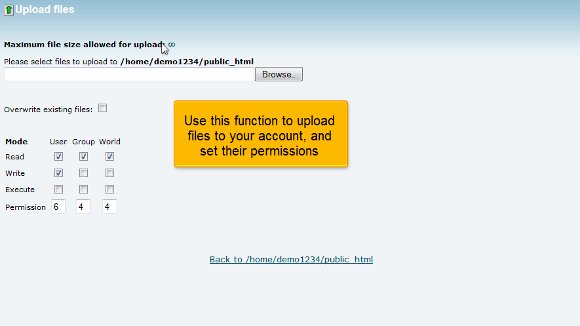
5) Now, click on the “Upload” button above on the top of the File manager tool bar. You can make use of this function to upload files to your account and to set their permissions.

cPanel

6) As a next step, we are going to create a new folder which is quite simple as generating a new file. In the cPanel file manager, click on the “New Folder” button that is placed on the File Manager tool bar. Basically, the New Folder button generates a new folder in which your files can be stored.

new folder

7) As soon as you click on the “New Folder” button, a dialogue box will pop up. Type the New folder name (in this case “newfolder’) in the space provided to describe the location where it needs to be created. Then, click the “Create New Folder” button. Now, you can see that the new folder has appeared in your preferred location.

file manager

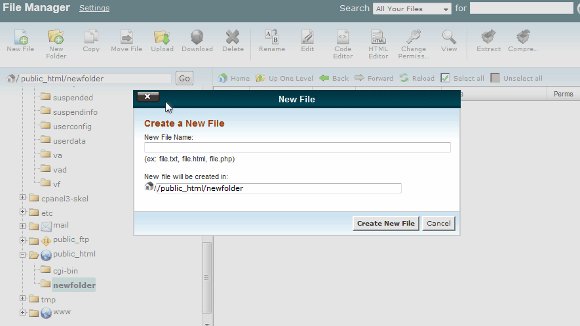
8) Now, in order to create a new file, click on the “New file” button above on the tool bar of the ‘File Manager’ interface. Basically, the New File button generates a new file with a “user-defined” file extension.

9) Now, a dialogue box will pop up. Enter the new file name (in this case “newfile.html’) in the space provided. Please remember to enter the right extension. Select a specific destination where the file needs to be saved. Now click on the “Create New file” button. Voila!! The file is successfully created.

cpanel file manager

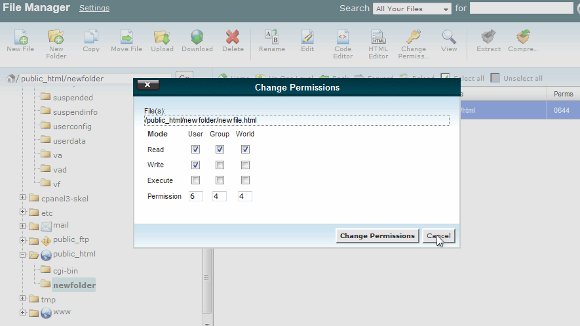
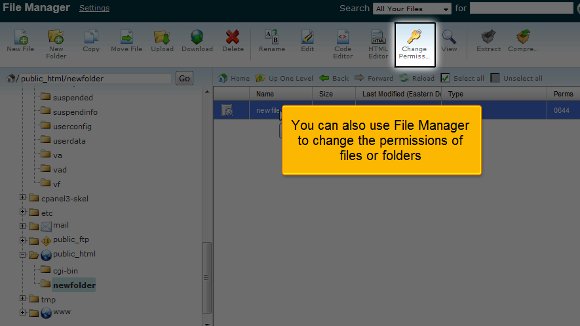
10) In the same way, you may also use cPanel File Manager interface to change the permissions of your files/ folders. Just click on the “change permission” button on the ‘File Manager’ tool bar to do so.

cPanel
cpanel

On the whole, the cPanel File Manager interface makes the process of managing the files & folders in your account into a simple one when you actually don’t have an access to an FTP tool. Hope this demo has clearly explained the process of using File Manager in cPanel!

Right Procedures to Backup Your Website in cPanel


Proper Procedures to Take Data Backup of a Website From cPanel

It is always suggested that you back up your website files before making the most significant changes. Backing up a website is a crucial part of regular accounts & any databases utilized by maintenance. In essence, the Backups region bestows a fundamental interface to download and store all or just a few of your website’s files, forwarders, filters and databases. This tool may be helpful for more skilled users who want to speed up the backup process.

In cPanel, there are 2 dissimilar methods through which you can create Data backups of your account with the help of the “”Backup Wizard””. You can create and download a single Data backup file of your whole account, which consists of all your files & databases, or you can generate & download a Data backup of these items in isolation.

One can generate a backup of his/her website very quickly. With the help of the cPanel Backups functionality, account backups can be done successfully for your hosting account. If your account is under 500MB, you can complete a Data backup version with a single mouse click. On the other hand, if the performance is enormous (more than 500MB), the complete automatic bacBackup files & databases must be backed up individually. First and foremost, you should understand the requirements of your website and decide what needs to be backed up or restored accordingly.

Steps to BacBackupwebsite in cPanel

The demonstration presented here has been done by assuming that the user has already logged in to his cPanel and is ready to learn about the website’s data backup procedures. To login to the cPanel, type your domain “”URL”” in your browser window and add “”/cpanel”” at the end of the URL.

You will be taken to the home page as soon as you log into your cPanel. You can find different sections on the home page to perform various unique operations.

1) Go to the ”Files” section and click the “”Backup Wizard”” icon. (The Backup Wizard is an intelligible interface that can generate a Data backup of the entire website, a fractional backup, or let a website restore from the previous bacBackupved. The Backup Wizard may be very helpful to new users). Immediately, you will be taken to the chief backup screen, where you can backup or restore your files in your hosting account. You will find three options in the backup screen: Backup/restore, Full or partial backup, and Download.

backup

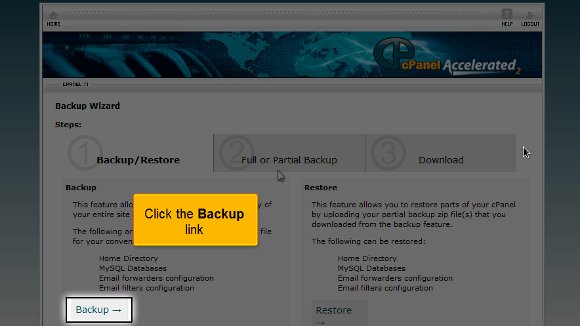
2) In the backup screen, click on the “”Backup”” link that can be found at the bottom of the page.

cpanel backup
cpanel

3) Here, you will be provided with the only choice of backing up a part of your hosting account. However, you need to create a full backup. For this reason, click the link that says “”Full Backup””.

backup cpanel

4) As soon as you click the “”Full Back up”” link, you’ll’ be taken to the page where a complete backup can be done. Now, choose your preferred backup destination from the dropdown box. In this case, we have selected the “”Home Directory”” as our backup destination.

backup restore

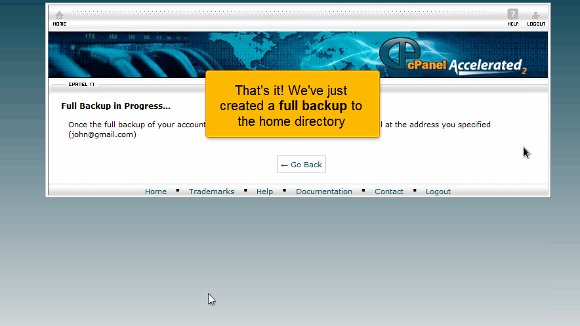
5) Now, click on the “”Generate Backup”” link at the bottom of the page. Great! We have just generated a full backup to our preferred destination (in our case, the Home directory).

backup

6) Now, click the “”Go back”” button to visit the ”Full Back” page again.

cpanel backup

7) Now, to download a copy of the bacBackup on your computer, click the link below the subheading “”Backups Available for Download””.

backup

8) save this to your computer by clicking “”Save file””. Now, we have successfully created a full backup.

backup

9) Similarly, restoring your files also includes simple and straightforward procedures. To do so, go to the Home page again.

restore

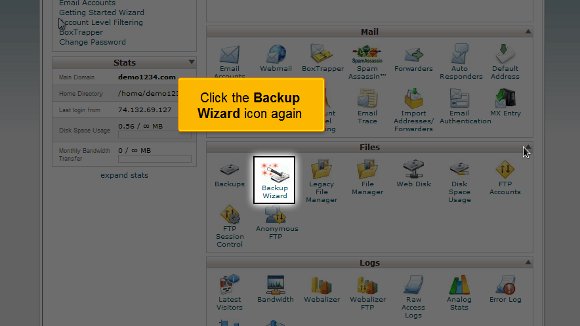
10) On the home page, Click the “”Backup Wizard”” icon under the Files section again.

backup restore

11) Now, click the “”Restore”” button on the Backup Wizard page. You will be taken to the cPanel Restore Wizard page now.

restore

12) In the Restore wizard page, you will receive several restoring options such as Home directory, MySQL databases, email forwards, and files. Select a specific type of restore that you wish to do. In our case, we are choosing to restore to the Home Directory.

cpanel restore

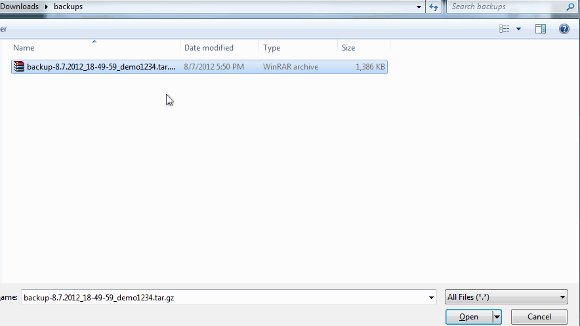
13) To click the browse button and the home directory Data backup, click the browse button.

cpanel restore
backup

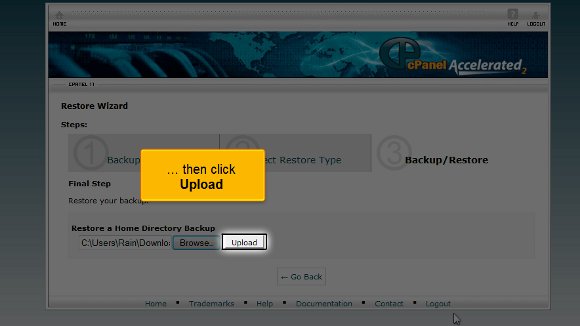
14) After locating the home directory Data backup, click the ”Upload” button.

restore

That’s’ it!! Your files have now been successfully restored!

Now, you know the proper methods to generate a Data backup with the help of cPanel and to restore files from a backup.

Update Your cPanel Contact Information


How To Update Your cPanel Contact Information

At heart, cPanel is a web hosting control panel based on “Unix”. cPanel bestows a graphical interface & other automation tools that are premeditated to abridge the website’s hosting process. Simply put, cPanel is user-friendly website management software premeditated for administrating specific domains and hosting accounts on a “Virtual Private Server (VPS)” or any other dedicated server. As a result, the end users can be in command of everything from eliminating/including email accounts to managing “MySQL” databases. In the bargain, cPanel can also be used in cooperation with the “Web Host Manager (WHM)” to include domains to a server, generate personal accounts, perform basic system & control panel maintenance and administer various features in hosting.

Configuration of cPanel:

Fundamentally, cPanel uses a “3 tier” configuration that bequeaths competencies for the website possessors (end-users), re-sellers and administrators. It also offers the vital ability to manage various website and server management characteristics through a typical web browser.

GUI:

The “Graphical User Interface”, shortly known as ‘GUI’ is a vital aspect of cPanel that donates tremendous accessibility to the end users. Besides GUI, cPanel also has ‘API-based’ admittance that permits web hosting groups, 3rd party software vendors and developers to computerize the standard system management processes.

The most “up-to-date” cPanel version can even handle the installation of ‘Red Hat Enterprise Linux (RHEL)’, ‘CloudLinux’ and ‘CentOS’.

Step-by-step procedures to update your contact information in cPanel:

In cPanel, one can manage numerous administrative/organizational tasks for a website. One such administrative task is updating a person’s contact information and preferences.

Readers should understand that the following demonstration has been provided by assuming that a particular user had already logged in to the cPanel and is now ready to discover the proper procedures for updating his/her contact information in cPanel.

Follow the ‘step-by-step instructions’ carefully to update your contact information and preferences:

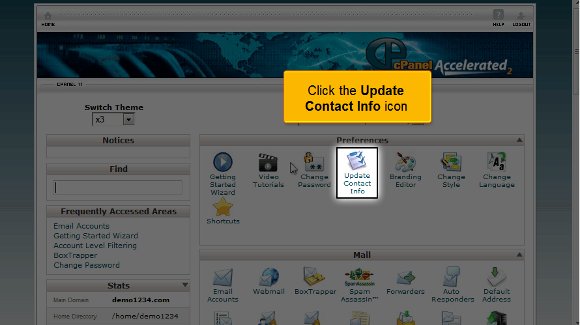
1) As soon as you enter the username & password in the cPanel login page, you will be taken to the cPanel home screen. In the cPanel home screen, you will see an “Update contact info” icon in the “Preferences” box.

cpanel

2) Now, click on the “Update contact info” icon.

contect info

3) As soon as you click on the “Update contact info” icon, you will be taken to the “Contact information & Preferences” page. Here, you will find 3 sections. The first and second sections are for entering your primary and secondary email addresses, whereas the last is for entering your contact preferences.

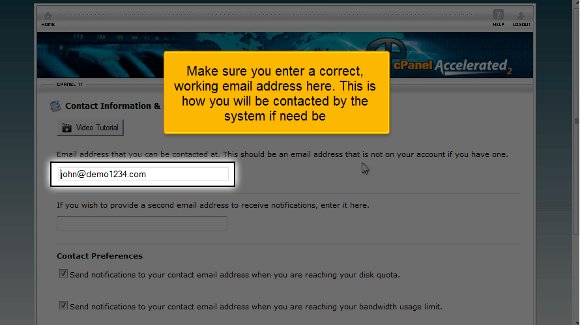
4) First, fill in your primary email address in the provided space. Note that the email address that you are entering here must be the one that is not on your account. Ensure you have entered the correct (working) email ID, as you need to make necessary contacts with the system.

contect info

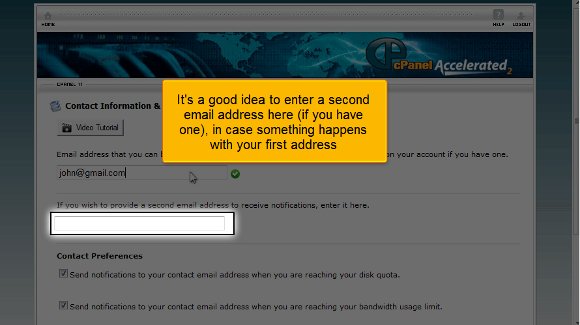
5) Generally, Users are recommended to enter a secondary email address in case of human error occurrences in the primary email id. So, move on to the next section and enter your secondary email address in the space given below. Nevertheless, make sure that you enter a valid email address here.

contect info

6) After entering the second email address, move to the third section, “Contact preferences”. In point of fact, this section is to understand the users’ preferences. Principally, this section is to identify whether a user would like to get notifications (through the contact email address) as soon as he/she reaches his/her disk quota, email account quota or bandwidth usage limit. So, if you prefer to get the notifications on these features, say ‘yes’.

cpanel contact info

7) After entering all the essential information, double-check once again to see whether you have entered the correct information in all the sections.

8) Now, click the “Save” button at the end of the page.

cpanel contact info

Great Job!!! You have updated all your contact information and preferences ingeniously. Also, you can confirm this by reading the statement – “Your contact information and preferences have been updated” at the end of the page. In future, when you reach the predetermined bandwidth & storage limits, you will be notified through proper email communication.

Users can follow the step-by-step instructions to update and maintain their contact information and preferences in cPanel.

Change the Primary Language in cPanel


How To Change the Primary Language in cPanel

No wonder cPanel is the chief control panel interface in the entire web hosting industry in the present day. cPanel is the solitary hosting control panel that is commercially obtainable. It is the only product trusted by the leading hosting contributors in the United States of America. Principally, cPanel uses a “graphical interface” that abridges the administration of a website to the highest degree. If truth to be told, cPanel shortens the tricky features of countless website management tools by offering users a user-friendly ‘front-end’ interface. cPanel helps you easily administer your FTP accounts, the vital files on your website, email accounts, sub-domains, add-on domains, and MySQL databases. In addition, it also donates statistics for your website.

In this tutorial, let’s learn about the different procedures to change the primary language in cPanel.

Read below to unearth the ‘trouble-free’ ways to change the language in cPanel without much hassle.

Step-by-step procedures to change the primary language in cPanel:

The following demo was presented, considering the user had already logged into his cPanel.

1) When you enter the username and Password, you will be taken to your cPanel home screen, where you can see the “Preferences” box on the apex of the home page.

2) Select the “Change Language” icon in the preferences box.

3) Click the “Change Language” icon

cPanel language Primary Language in cPanel

Change the primary language in cPanel:

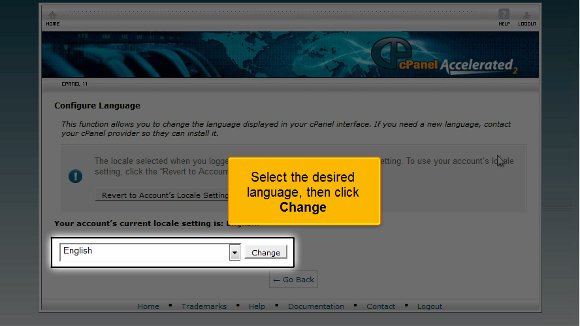
4) you will be taken to the “Configure Language” page. This function is provided to help you change the primary language that’s exhibited in your control panel interface.

5) Here, you will notice a dropdown box in which several languages in the world are listed.

6) choose your preferred language from the language dropdown box. In this demo, we changed the language from English to “Spanish (espanol)”.

cPanel language

7) Select the Spanish language from the dropdown box and click the “Change” button.

cPanel language

8) Cool!! You have successfully changed the primary language in cPanel from English to Spanish.

9) To confirm the primary language in cPanel change, click the “home” button to visit the home page.

10) On the home page, if you steer from end to end of your cPanel, you will be able to observe that the (original) primary language (English) has been changed to the recently selected language (Spanish).

11) OK now! To change the primary language back to the original one (in our case, English), you just have to repeat the entire process again. Simple right!!

12) go ahead and click on the “Cambiar Lenguaje” (Change Language) icon in the “Preferencias” (Preferences) box.

13) For a second time, you will have to select the original language, “English”, from the language dropdown box and click on the “change” button. That’s it!! Your primary language is now changed to “English”.

14) To confirm whether the language has been changed to English, click the home button and visit the home screen.

15) On the home page, if you manoeuvre from the first to the last of your control panel, you will discover that the language (Spanish) has been changed to English again.

Now, you have become skilled at changing the primary language in Cpanel. Tag along the step-by-step instructions given above to play around various languages in your cPanel.

Change Your cPanel Style


How TO Change Your cPanel

cPanel, also known as the control panel, is basically a graphical “web-based” control panel that lends you a hand in managing your website & hosting account rapidly and effortlessly. cPanel is essentially a website administration program that can administer diverse features of your website. cPanel offers you an absolute administration over a cosmic number of functions by reshuffling several functional processes, for example:

  • Generating databases
  • Administrating website files
  • Creating autoresponders and email accounts
  • Set up software on your website

cPanel has quickly developed into the most ‘well-liked’ web hosting control panel that sprints millions of websites all over the globe. In essence, cPanel was created to bestow both website owners & servers the essential control on their properties. Whether a user is administrating a single or 100’s of websites and/or servers, the idiot-proof “point-and-click” interface of cPanel will let the user modify his/her web-hosting practice that best suits his/her requirements.

In this tutorial, you will learn about the proper methods to change your cPanel style.

Step-by-step instructions to change your cPanel style:

The following demo assumes that the user has already logged into his/her cPanel account.

1) The moment you log into your cPanel, you will be taken to the home screen, where you can find the “Preferences” box on the top.

2) In the Preferences box, an icon will be called “Change styles”.

3) Click the “Change styles” icon.

00-change-style

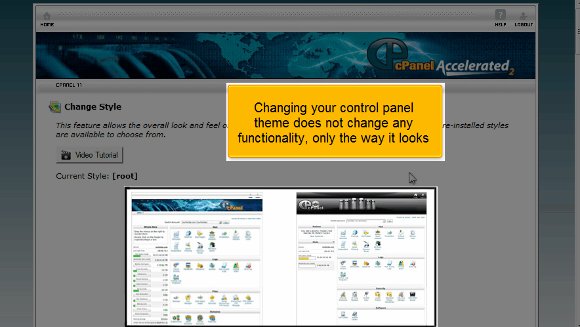
4) you will be taken to the page where you can change your cPanel style. Fundamentally, changing your cPanel style will not affect the core functionality of your cPanel. On the other hand, it just affects the “feel and appearance (look)” of cPanel. Also, some styles affect the association of your cPanel icons. One can select from an array of cPanel styles such as “[root]” style, “black ice” style, “blue_lagoon” style, “business2business” style, “clocks” style, “crimson_smoke” style, “fall theme” style, “mobile” style, “monsoon” style, “motor_city” style, “servers” style and “sundaymorning” style.

01-choose-style

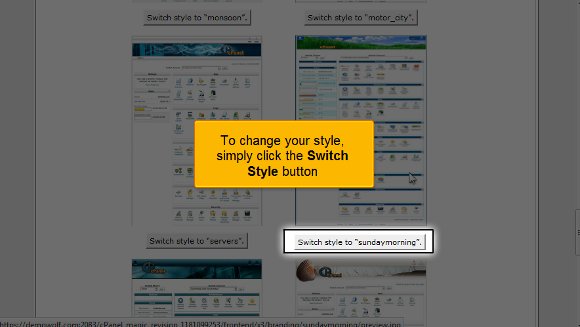
5) select your favourite cPanel style and click that “switch style” button. For example, if you wish to change your cPanel style to “Sundaymorning” type, then click the button that says “switch style to “Sundaymorning”.

02-switch-style cPanel Style

6) Voila!!! You have successfully changed your cPanel style to “sundaymorning” style. This can be confirmed by reading the statement “Your style has been changed” on the screen.

7) To verify whether your cPanel style has been changed to your preferred style mode (in this case, “sundaymorning”), click the home button that is on the top of the screen.

8) In the home screen, you will notice that the appearance (look) of your panel has been changed to “sundaymorning”.

03-change-style

9) Now, in an attempt to change your cPanel style back to its original style (“[root]”), you just have to repeat the whole process once more.

10) Click the “change style” icon on the preferences box.

04-change-default

11) Now, you will be taken to the “change styles” page, where you can find an array of cPanel styles.

12) Click the button “Switch style to “[root]”.

05-switch-default

13) Great!! Your cPanel style has been successfully changed to its original “[root]” style.

06-default-style

14) You can confirm the style change by visiting the home screen.

Awesome!! Now, you know the proper procedures to change your cPanel style professionally. Follow the steps above to play with different style changes in your control panel.

Create desktop shortcuts for cPanel


How  To Create Desktop Shortcuts for cPanel

At the outset, your web hosting control panel (cPanel) may appear obscure to you. For this reason, we have offered you some helpful video tutorials to ease learning several functional operations in cPanel. Primarily, Shortcuts will generate a speedy technique to access your cPanel interface (or) webmail by developing a shortcut. A shortcut is an exclusive ‘icon’ on your browser or desktop that will access a preferred aspect or application with just a click of your mouse. One can set up a shortcut by holding, dragging or clicking on the links to a page of your browser or desktop toolbar. Doing so will automatically add the shortcut to your desktop or toolbar.

The following tutorial will show you the easy ways to create shortcuts to pages within your cPanel to add them to your desktop bookmarks and browser to make it rapid and straightforward to reach the pages you use the most regularly.

Various Steps to Setup Desktop Shortcuts for Your cPanel

Once logged in to your cPanel, you can continue setting up desktop shortcuts for the web hosting control panel and webmail. In reality, cPanel shortcuts are the essential links that can be added to your browser or desktop’s toolbar. This is considered a simple and straightforward technique to work with your cPanel. One can also set up cPanel shortcuts to access his/her webmail unswervingly.

This demo is presented by assuming that the user has already logged into his/her cPanel account and is ready to learn the proper procedures to set up desktop shortcuts.

1) Desktop shortcuts for cPanel: After logging in to your cPanel, you will be taken to the home screen, which bestows access to all essential cPanel functions. On the home screen, click the “Shortcuts” icon that can be found under the ‘Preferences’ category. The data enclosed within the Preferences box illustrates the features placed in the cPanel interface. These vital features consist of standard cPanel settings and a setup wizard.

desktop shortcuts for cPanel

2) Desktop shortcuts for cPanel: When you click the “Shortcuts” icon, you will be navigated to the page where you can access the shortcuts in cPanel. To be precise, you will be taken to the “Shortcuts page”, where you can find a list of available shortcuts.

cPanel add shortcuts

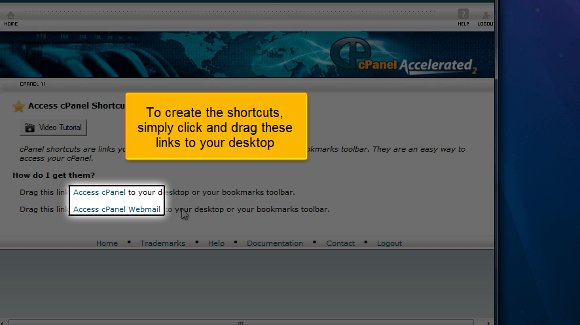
3) Desktop shortcuts for cPanel: Now, all you have to do is just click & drag the 2 links (“Access cPanel” and “Access cPanel webmail”) that are provided on the “Access cPanel Shortcuts” page to your desktop.

cPanel

4) Desktop shortcuts for cPanel: Check whether you can find the two shortcuts for cPanel, ‘control panel’ and ‘webmail’ on your desktop. Once you get them on your desktop, it’s just a matter of one click on the shortcuts to quickly access the page(s) in your browser.

cpanel shortcuts

Groovy!! You know the simple procedures to set up desktop shortcuts for your cPanel. Tag along the steps given above to create shortcuts in cPanel. Remember that your cPanel or control panel is an authoritative tool to control several aspects of your website. So, go through all our helpful video tutorials that guarantee an unfussy use of your cPanel.