The System will use Artificial Intelligence(AI) to help improve the air quality over targeted sectors of Delhi /NCR.
The Commission for Air Quality Management (CAQM) in NCR and adjoining areas have begun setting up a decision support system (DSS) with web, GIS, and multi-model-based procedural and planning decision support tools.
This tool will help immensely in capturing the static and dynamic features of the emissions from various sources. Using a chemical transport model, it will have an integrated framework to handle both primary and secondary pollutants. The System will also be able to take the source-specific interventions with the framework to estimate the benefits of interventions. It will focus on presenting the best results in a comprehensive, user-friendly, and straightforward format for different users.
The Commission has entrusted the task to expert groups from reputed knowledge institutions of the country given below for framework development of Air Quality Management DSS for Delhi:-
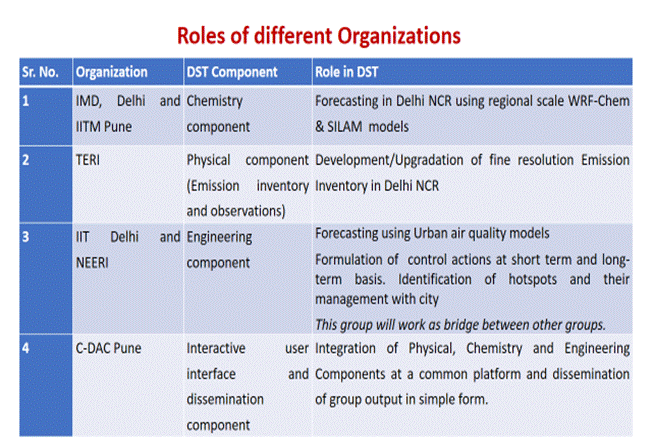
The Air Quality Management Decision Support Tool (DST) integrates an emissions inventory development application and database; regional, local, and source–receptor modelling; and Geographical Information System (GIS) based visualization tools in a software framework to build a robust system to formulate and implement source-specific interventions to improve the air quality over targeted sectors of Delhi / NCR. Identification of source-specific interventions by the DST is deliberated with the involvement of stakeholders.
The covered sources will include industries, transport, power plants, residential, DG sets, road dust, agricultural burning, refuse burning, construction dust, ammonia, volatile organic compounds, and landfills. For instance, municipalities, industrial associations, industrial development authorities, etc., would be the stakeholders in identifying interventions related to waste burning and industrial source pollution.
Upon identification of feasible interventions, the artificial intelligence-based expert system has a hierarchical database of simulated scenarios, potentially assessing the impact of the identified possible intervention, which would be implemented by regulatory organizations such as CPCB and state PCBs. The on-field implementation is monitored independently by credible citizen watch groups and professional NGOs. Finally, air quality data collected near the area where the intervention is implemented will be analyzed to understand the real-world benefits of such intervention. Source: Press Release Release ID: 1691200 Date: January 22, 2021 PIB Delhi Ministry of Environment, Forest and Climate Change


 Ananova
You must be logged in to post a comment.