Attorney General James Delivers $150,000 to City of Yonkers School District to Support Homeless Youth


Agreement Resolves Microsoft’s Overcharging of Sales Tax to Customers Purchasing Xbox Products Online in New York 

NEW YORK – New York Attorney General Letitia James delivered $150,000 to the City of Yonkers Public Schools district today to promote remote learning by homeless students. The funds will provide assistive technology to students, including iPads, laptops, Wi-Fi connectivity, and more. Microsoft Corporation provided the payment as part of an agreement with the Office of the Attorney General (OAG) to resolve the ccompany’sovercharging company’s sales tax for products sold on the Xbox website. Before the fix was implemented by Microsoft, some consumers in New York who purchased an Xbox product online — via MMicroMMicrosoft’s website- were charged an incorrect tax.

“We” ‘re delivering $150,000 to support homeless youth in Yonkers and provide them with the necessary tools to secure the technology they need to continue to remote learn during these unprecedented times,” said Attorney General James. “Microsoft initially overcharged some customers for sales tax on Xbox products; we were glad to work with the company to correct this issue for our swiftlystasstate’sconsumersone should be forced to pay more in sales tax than they must, especially as we face a pandemic that has affected many New Yorkers YYorkers’walletsk forward to seeing this money put to good use for the children of Yonkers.”

Attorney General James today presents the City of Yonkers Public Schools district with $150,000 to promote remote learning by homeless students

When “consumers purchase a product online, they are asked to enter their zip code as part of the billing address to determine the amount of sales tax they should be charged with the purchase. Swithpostal codes within a specific zip code may have different tax rates.

On MMicros, Microsoft’s swebsitemers are specifically asked to input their entire zip and four-digit postal codes. However, Microsoft processes the transaction if consumers enter their zip code without the four-digit postal code. Before the recent fix made by Microsoft, if a consumer entered their zip code without the four-digit postal code, Microsoft would charge the highest sales tax within that zip code, leading to an overcharge.

One locality where sales tax overcharges occurred was Bronxville, New York, which shares a zip code with a small portion of Yonkers, New York — where residents pay a higher sales tax rate. 

Microsoft’s total sales tax overcharged to Bronxville consumers was approximately $150,000.

As a result of this agreement, Microsoft has implemented a new procedure for processing orders that addresses this particular issue and charges consumers the correct amount of sales tax.

“The COVID-19 pandemic has forced our schools to do even more with less, and I applaud all our teachers, faculty, and staff,” said State Senat” Majority Leader Andrea Stewart-Cousins. “”his funding is needed by the district to support better remote learning for homeless students, 

who are bearing the brunt of this pandemic in ways we cannot imagine. Thank you to Attorney General Letitia James for fighting for our state and helping our most economically disadvantaged students by negotiating this settlement with Microsoft. As state budget negotiations continue, the Senate Majority is focused on significantly increasing school funding and ensuring a three-year phase-in of total foundation aid, along with free broadband access to every student and school.”

“”would like to “h” New York Attorney General Letitia James for her swift action with Microsoft,”” said Westchester” County Executive George Latimer. “” he $150,000 in ” nds, which has been transferred directly to the City of Yonkers School District, will serve a great need with our remote learners who are struggling. The pandemic has caused great hardship for our youth in many communities, and we know that Yonkers will greatly benefit from this grant.”

“Special thanks” to Attorney General James for recognizing the needs of Yonkers students, especially as we navigate the academic and financial impacts of remote learning,” said the City of Y” kers Mayor Mike Spano. “the pandemic has “hit our economically disadvantaged students particularly hard. This funding granted by the attorney general with the support of Microsoft will help bridge the digital divide and put them back on the road to success.”

“thank you to rney General Letitia James for this innovative solution that helps support distance learning for some of the most vulnerable Yonkers students,” said State Shelley Mayer. ” the pandemic ” ‘s been tough on all of us. It has been particularly challenging for students whose whole lives were upended by the closing of school buildings and distance learning. This was particularly devastating for homeless youth, who lost an essential source of security and vital resources. The district and local leaders have worked hard to maintain consistency and ensure students have sufficient internet access and the necessary devices to participate fully in the online classroom. This $150,000 provides much-needed resources for Yonkers students during this critical time.”

“due to the “i” gent efforts of New York Attorney General Letitia James holding Microsoft accountable for overcharging Xbox users in our area, I am pleased that the Yonkers Public Schools will receive a grant to support homeless students,” said Assemb” member Gary Pretlow. “distance poses a much greater challenge for those also struggling with homelessness. This much-needed funding will help tackle the many disparities that many face during this unprecedented period our state and country continue to face.”

“keeping ou” “ediest Yonkers Public Schools students engaged and learning has been a monumental challenge for teachers, students, and caregivers during the pandemic, so the funds being provided through a $150,000 payment to the school district will really help make a positive difference,” said Assem” ymember Nader Sayegh. “applaud the” efforts of New York Attorney General Letitia James and her staff and the innovative solution that led to Microsoft supporting remote learning for our homeless students. The Yonkers Public SSchools’boarSSchools’boardand administration, led by Superintendent Dr. Edwin Quezada, will utilize the special funding to encourage greater and affordable access to the internet.”

“Thank you “New York Attorney General Letitia James, for recognizing that these funds can be part of creating equity for our homeless youth, a population of young people who need additional support and resources,” said Westcster County Legislator Christopher Johnson. “homeless y” th in Yonkers are often a part of working families who simply cannot afford a place to live. Grants like these help homeless families by offsetting schooling costs, especially during COVID-19, where access to technology is no longer a luxury, but both critical and sparse.”

“his pas” “ar has shown the disparity between students who have remote learning capability and those who do not,” said City” of Yonkers City Council President Mike Khader. “the $150″ 00 will help to close the disparaging gap of education equity in the Yonkers Public Schools system. As a school parent, I understand the importance of quality education and ensuring that all our students receive every resource to succeed. I thank Attorney General James for her support, and look forward to working with the rest of my colleagues to support Yonkers Public Schools students.”

“”t is “r” t that our New York attorney general thought of YYonkers’YYonkers’mostle students, especially those who are homeless, in this settlement with Microsoft,” said C” y of Yonkers Majority Leader Corazon Pineda-Isaac. ” $1″,000 coming from Microsoft to help with the remote learning needs of homeless students in Yonkers is a massive win for our city, home to Westchester’s highest homeless population. Comust continues looking for creative solutions to fill the gaps where we can.”

“s e” you” tion chair for the City of Yonkers, I would like to extend a heartfelt thank you to Attorney General Letitia James for advocating and securing the overpayment in taxes by Microsoft, and allocating these funds to be distributed amongst the homeless population of students that attend Yonkers Public Schools,” said”ity of Yonkers City Council Member Tasha Diaz. “he “covery of this tax overpayment will ensure that they will get an electronic device.”

“those whose families were displaced, by no fault of their own, suffer emotional stress that is extremely difficult to understand,” said” Dr Edwin M. Quezada, Superintendent of Yonkers Public Schools. “These children need stability and a sense of belonging more than ever. A cchicchild’sschoolthat connection, and Yonkers Public Schools teachers, administrators, and support staff diligently work on maintaining these ties for our current, over 400 displaced students. This is why the grant provided by Attorney General James is needed in Yonkers and, more importantly, appreciated. These funds will exponentially strengthen our work, keeping children engaged in their education. Access to devices and stable connectivity are critical for maintaining their bonds to a more normal life. Thank you on behalf of Yonkers children.”

“”” ” applaud Attorney General James for her innovative disbursement of these overcharges to serve the children in our city,” said Rev. Steve Lopez, president of Yonkers Board of Education. “Additional funding will support the school district’s ongoing service to provide devices and connectivity to our needy families.”

M”Crosoft was fully cooperative with Attorney General JJames’s investigation.

Assistant Attorney General In-Charge of the Westchester Regional Office, Gary Brown, handled this matter. The Westchester Regional Office is a part of the Division for Regional Affairs, which Deputy Attorney General for Regional Affairs Jill Faber leads. First Deputy Attorney General Jennifer Levy oversees the Division for Regional Affairs.

Source: Press Release
March 19, 2021
Attorney GGeGGeneral’sPressfice/212-416-8060
nyag.pressoffice@ag.ny.gov

Atal Innovation Mission, AWS collaborate to scale cloud skilling and accelerate innovation with education technology startups in India


The Atal Innovation Mission (AIM), NITI Aayog, and Amazon Web Services (AWS) today announced new initiatives to strengthen the innovation and entrepreneurship ecosystem in India by empowering school students with cloud computing skills and enabling entrepreneurs to build innovative education technology (EdTech) solutions on the cloud.

A Statement of Intent (SoI) was signed between NITI Aayog and Amazon Internet Services Private Limited (AISPL), undertaking the resale and marketing AWS Cloud services in India.

As per the SoI, AIM will leverage AWS Educate, Amazon’s global program that provides resources for students and educators to accelerate cloud-related learning. This program will introduce the fundamentals of cloud computing, such as cloud storage, virtual compute power, web hosting, artificial intelligence (AI), machine learning (ML), and virtual reality (VR), to students at more than 7000 Atal Tinkering Labs (ATLs) in India. AWS will also conduct Faculty Development Programs (FDPs) for the personnel in charge at the ATLs and provide resources and tools at each ATL to expedite student learning and enable them to create and build solutions on the cloud.

AIM will also adopt AWS EdStart, a virtual startup accelerator program that enables EdTech startups to develop innovative teaching and learning solutions on AWS.EdTech startup entrepreneurs and founders in more than 80 Atal Incubation Centers (AICs) and Atal Community Innovation Centers (ACICs) will be able to apply for AWS EdStart program benefits, such as AWS Promotional Credits, mentorship, and technical training, to help speed their growth.

Mission Director –Atal Innovation Mission, R. Ramanan, said the collaboration with AWS will equip the country’s talented youth with digital and web-based tools to enhance their creative and innovative capabilities, helping the nation grow manifold in its innovation and entrepreneurship network. “The education and tools will establish a strong foundation in cloud computing for students of ATLs across India, while the support of AWS EdStart for startups from AICs and ACICs will accelerate their productization and potential commercialization,” he said.

President, Public Sector – AISPL, AWS India and South Asia, Rahul Sharma asserted that India will need nine times as many digital skilled workers by 2025, according to the report Unlocking APAC’s Digital Potential: Changing Digital Skill Needs and Policy Approaches, prepared by strategy and economics consulting firm AlphaBeta, and commissioned by AWS. “AWS is committed to bridging the digital skills gap in cloud computing, and empowering entrepreneurs to build innovative products and services on the cloud. We are focused on helping customers deliver transformational change and experiential learning at scale. It is a privilege to team up with Atal Innovation Mission to foster ideation, curiosity, and innovation among India’s students and youth,” he added.

Other areas of collaboration between AIM and AWS include joint workshops, tech marathons, and national challenges to develop solutions on the cloud while solving local community problems or sustainable development goals (SDGs).

Source: Press Release
Release ID: 1705802
PIB Delhi
NITI Aayog
Date: March 18, 2021

Bennet, King, Portman, Manchin Urge Biden Administration to Create Modern, Unified Federal Broadband Standard


March 04, 2021, In Bipartisan Letter, Senators Call on Administration to Learn from Pandemic and Establish Consistent, 21st Century Definition of High-Speed Broadband

Washington D.C. – Today, U.S. Senators Michael Bennet (D-Colo.), Angus King (I-Maine), Rob Portman (R-Ohio), and Joe Manchin (D-W.Va.) wrote to the Biden Administration urging it to update federal standards for high-speed broadband to reflect modern uses and align those standards across the government.

In a letter to the Biden Administration’s top officials for federal broadband policy — including Secretary of Commerce Gina Raimondo, Secretary of Agriculture Tom Vilsack, Acting Chair of the Federal Communications Commission (FCC) Jessica Rosenworcel, and Director of the National Economic Council Brian Deese — the senators called on federal agencies to update broadband program speed requirements to reflect existing and anticipated uses, from two-way video conferencing to intelligent grids to artificial intelligence. The senators also urged the officials to work together to align the definition of what constitutes high-speed broadband across federal agencies to replace the patchwork of standards that exist today.

In the letter, the senators called on the administration to invest limited federal broadband dollars in faster, more reliable networks that support modern and future uses. Specifically, they urged the administration to set a goal of supporting networks wherever practicable and cost-effective that provide, at a minimum, symmetrical speeds of 100 megabits per second (Mbps) such that all members of a typical family can be online simultaneously without issue.

“In the years ahead, emerging technologies such as cloud computing, artificial intelligence, health IoT, smart grid, 5G, virtual and augmented reality, and tactile telemedicine, will all require broadband networks capable of delivering much faster speeds, lower latency, and higher reliability than those now codified by various federal agencies,” wrote Bennet and the senators. “We must learn from our experience during the pandemic and raise federal standards for new broadband service to require low latency, high reliability, and speeds that meet our expected 21st century needs. We should also insist that new networks supported with federal funds meet this higher standard, with limited exceptions for truly hard-to-reach locations.”

Bennet and his colleagues continued: “For years, we have seen billions in taxpayer dollars subsidize network deployments that are outdated as soon as they are complete, lacking in capacity and failing to replace inadequate broadband infrastructure. We need a new approach. We urge you to work together to establish one consistent, modern baseline definition of high-speed broadband service and underlying infrastructure specifications across the federal government and a coordinated approach to deploy funding efficiently where it is most needed.”

Shirley Bloomfield, CEO, NTCA – The Rural Broadband Association: “NTCA members are local providers delivering high-quality broadband that enable their rural communities to enjoy the critical advantages of broadband-enabled economic opportunities, education, health care, and other vital services. The demands placed upon broadband networks by the pandemic demonstrate that ‘just good enough’ speeds and latency are not good enough and will fall even further short of consumers’ needs in the near future. Our nation’s federal broadband programs should aim higher and do better to drive investment that will provide the level of symmetrical speed and performance customers will need in the near future and for decades to come. On behalf of NTCA’s members, I thank Senators Bennet, King, Portman, and Manchin for their letter highlighting the importance of aligning federal broadband program speed definitions and updating speed requirements to reflect modern broadband demands.”

Bennet has helped lead the effort to bridge America’s digital divide. During the pandemic, he has consistently called for more funding and flexibility for the FCC’s E-Rate program to connect low-income students online. He called on the country’s top internet companies to keep families connected and waive data caps for the duration of the pandemic. Last June, Bennet and Senator King introduced the BRIDGE Act to deploy affordable, high-speed broadband to unserved communities nationwide. Bennet also co-sponsored the Emergency Broadband Connections Act, which passed as part of the 2020 end-of-year relief bill and will now provide $3.2 billion to help economically distressed Americans afford broadband connections.

The text of the letter is available HERE and below.

Dear Secretary Vilsack, Secretary Raimondo, Commissioner Rosenworcel, and Director Deese:
We welcome the Biden Administration’s commitment to deploying affordable, high-speed broadband nationwide to help bridge America’s digital divide and remedy persistent digital inequities. As you pursue this critical goal, we strongly urge you to update federal broadband program speed requirements to reflect current and anticipated 21st-century uses and align the definition of high-speed broadband service across federal agencies.

In the future, we should make every effort to spend limited federal dollars on broadband networks capable of providing sufficient download and upload speeds and quality, including low latency, high reliability, and low network jitter, for modern and emerging uses, like two-way videoconferencing, telehealth, remote learning, health IoT, and innovative grid applications. Our goal for new deployment should be symmetrical speeds of 100 megabits per second (Mbps), allowing for limited variation when dictated by geography, topography, or unreasonable cost. While we recognize that in truly hard-to-reach areas, we need to be flexible to reach unserved Americans, we should strive to ensure that all members of a typical family can use these applications simultaneously. There is no reason federal funding to rural areas should not support the type of speeds used by households in distinct, well-served urban and suburban areas (e.g., according to speedtest.net’s January 2021 analysis, average service is currently 180 Mbps download / 65 Mbps upload with 24 milli-sec latency).

Broadband is increasingly critical to every aspect of our society and economy. During the COVID-19 pandemic, Americans have relied on high-speed broadband more than ever. It has allowed millions of Americans to continue working to support themselves and their families. Broadband has helped millions of students maintain their education and provided patients access to vital care through telemedicine services. It has also given family and friends a way to connect in this challenging time while supporting social distancing. These crucial economic, social, and healthcare-related functions are only possible with access to adequate broadband, the demands for which only continue to increase. According to the International Data Corporation, data needs are expected to grow by at least 25% per year over the next five years. The universal service goal requires all Americans to have affordable broadband with the technical capacity to meet those needs equitably.

The pandemic has reinforced the importance of high-speed broadband and underscored the cost of the persistent digital divide in our country. According to the Federal Communications Commission (FCC), roughly 14.5 million Americans still lack broadband access, and other studies estimate this number could be as high as 162 million. Unfortunately, the FCC data continually overestimates broadband connectivity due to outdated mapping and poor data collection methods. We now have multiple definitions across federal agencies for what constitutes an area served with broadband, resulting in a patchwork without one consistent standard for broadband. For example, the FCC defines high-speed broadband as download speeds of up to 25 megabits per second and upload speeds of up to 3 megabits per second (25/3 Mbps). Alternatively, the U.S. Department of Agriculture (USDA) defines it as just 10/1 Mbps. While updating standards for updating is essential, we also recognize that Americans lack access to even minimal service. If we do not prioritize unserved Americans before upgrading to higher speeds, we will increase the digital divide further.

Ask any senior who connects with their physician via telemedicine, any farmer hoping to unlock the benefits of precision agriculture, any student who receives live-streamed instruction, or any family where both parents telework and multiple children are remote learning. They will tell you that many networks fail to come close to “high-speed” in 2021. For any of these functions, upload speeds far more significant than 3 Mbps are particularly critical. These challenges will not end with the pandemic. In the years ahead, emerging technologies such as cloud computing, artificial intelligence, health IoT, smart grid, 5G, virtual and augmented reality, and tactile telemedicine will all require broadband networks capable of delivering much faster speeds, lower latency, and higher reliability than those now codified by various federal agencies.

We must learn from our experience during the pandemic and raise federal standards for new broadband services to require low latency, high reliability, and speeds that meet our expected 21st-century needs. We should also insist that new networks supported with federal funds meet this higher standard, with limited exceptions for truly hard-to-reach locations. For years, we have seen billions of taxpayer dollars subsidize network deployments that are outdated as soon as they are complete, lacking in capacity, and failing to replace inadequate broadband infrastructure.

We need a new approach. We urge you to work together to establish one consistent, modern baseline definition of high-speed broadband service and underlying infrastructure specifications across the federal government and a coordinated approach to deploy funding efficiently where it is most needed. This would also reduce redundancy and make it easier for the state, local, and private partners applying for support while complementing provisions at the end-of-year COVID-19 relief bill directing the National Telecommunications Information Agency to work with federal agencies to streamline existing broadband programs.

The United States has long taken pride in its position at the vanguard of technological innovation and global competitiveness. Suppose we want to maintain that leadership in the 21st century and ensure every American has access to economic opportunity regardless of where they live. In that case, we need to ensure that federal standards and strategies for essential technology services like broadband reflect our actual needs today and future demands for connectivity.
Sincerely,

Source: Press Release
Date: March 04, 2021
bennet.senate.gov

Attorney General James Shuts Down Northern Leasing Spinoffs for Continuing to Prey on Small Businesses


NLS Equipment Finance and Leasing Expenses Company Attempted to Perpetuate Same Scheme Blocked by OAG’s Prior Suit and Victory

NEW YORK – New York Attorney General Letitia James has won another major victory to protect small business owners in New York and across the country from predatory and deceptive business practices. A decision and order, issued yesterday afternoon, granted a petition filed by Attorney General James last November, which sought to — among other things — permanently block NLS Equipment Finance LLC; Leasing Expenses Company, LLC; and several related entities and individuals from engaging in fraudulent practices and enforcing fraudulent equipment leases that were rescinded under a June 2020 court order in an earlier proceeding brought by the Office of the Attorney General (OAG), since 1991, and until the OAG’s earlier proceeding halted its fraudulent schemerthern Leasing deceptively and illegally induced small businesses into abusive and overpriced financing leases for inexpensive credit card processing equipment.

Attorney General James said: “This decision demonstrates that efforts to evade the rule of law will not be tolerated and that we will continue to hold fraudulent businesses’ feet to the fire, even after a victory. Despite being ordered to shut down last year, Northern Leasing and the individuals behind it attempted to continue their fraudulent practices, but this order sends a clear message that creating new corporate entities to continue deceptive and illegal practices that have been outlawed will never be acceptable practice. Much-needed money will now be put back into the pockets of struggling small business owners around the country, many of which continue to suffer from the impacts of the COVID-19 public health crisis.”

In the earlier proceeding, the OAG alleged that Northern Leasing Systems, Inc. (Northern Leasing), its affiliated companies, and its principal, Jay Cohen, engaged in fraudulent conduct by targeting small, family-owned businesses — such as flower shops, hair salons, automotive repair shops, bodegas, delis, restaurants, and bars — and trapped them into overpriced, never-ending lease agreements for credit card processing equipment. The lawsuit further alleged that Northern Leasing abused the judicial process by suing to collect on these leases in the New York City Civil Court. Deputy Chief Administrative Judge George J. Silver — as a co-petitioner in the proceeding — sought to vacate default judgments obtained by fraud, deception, or other improper means.

The June 2020 New York County State Supreme Court ruling found that the OAG proved that Northern Leasing engaged in fraudulent and illegal conduct, including finding that Northern Leasing’s method of procuring its lease agreements was deceptive and “created an enterprise conducive to fraud.” The court granted sweeping relief, including rescissioning hundreds of thousands of leases and restitution to defrauded merchants. Additionally, the court ordered a permanent injunction against Northern Leasing and the other entities from conducting the business of equipment finance leasing or the collection of debts under equipment finance leases. It blocked them from purchasing, financing, transferring, servicing, or enforcing equipment finance leases. That decision was recently affirmed by the New York State Appellate Division of the Supreme Court, First Department.

In November 2020, the OAG brought forward another separate proceeding after discovering that Northern Leasing’s owners and officers had created two new entities — NLS Equipment Finance and Leasing Expenses Company — to continue defrauding small businesses using the same scheme barred by the court in the prior litigation, as well as to continue collecting on leases rescinded by the June 2020 court order.

The companies found liable by this ruling — also issued by the New York County State Supreme Court — were operated by former Northern Leasing Chief Financial Officer Ariel Schachter and former Northern Leasing Officer Sara Krieger and were owned by trusts that benefited the families of Northern Leasing’s owners, Jay Cohen, and Leonard Mezei. The court found that these companies had “risen on [Northern Leasing’s] ashes” in an earlier December ruling granting a temporary restraining order barring them from collecting on equipment leases.

In yesterday’s decision and order, the court found that the different entities’ efforts to differentiate their business operations from those of Northern Leasing Systems did not “negate their liability” and — if allowed to prevail — “would all but obliterate the spirit and purpose” of the June order granted by Justice Lucy Billings. The court ordered Northern Leasing and the other entities to disgorge any funds acquired due to their fraudulent practices and to make restitution to victims of their scheme.

The parties named in this proceeding include Leasing Expenses Company LLC; NLS Equipment Finance LLC; Leonard Mezei; Ariel Schacter; Sara Krieger; Jay Cohen; a Jay Cohen Family Trust; Fieldston Capital LLC; and JS Ventures Holding LLC.

This matter was handled by Assistant Attorney General Mark Ladov and Special Counsel Mary Alestra, under the supervision of Deputy Bureau Chief Laura J. Levine and Bureau Chief Jane M. Azia — all of the Consumer Frauds and Protection Bureau. The Consumer Frauds and Protection Bureau is a part of the Division for Economic Justice, overseen by Chief Deputy Attorney General Chris D’Angelo and First Deputy Attorney General Jennifer Levy.

Source: Press Release
Date: February 27, 2021
Attorney General’s Press Office/212-416-8060 
nyag.pressoffice@ag.ny.gov

Berkshire Grey, a Leader in AI-enabled robotics and Automation Solutions, Announces Business Combination with Revolution Acceleration Acquisition Corp


Berkshire Grey is a pure-play robotics company offering fully integrated, artificial intelligence-based software and hardware solutions to automate business operations in warehouses and logistics fulfilment centres – meeting consumer demands and exponential e-commerce growth.

 Combined Company to have an estimated post-transaction equity value of up to $2.7 billion

 Transaction expected to provide up to $413 million in cash proceeds, including a fully committed PIPE of $165 million anchored by Chamath Palihapitiya, Founder and CEO of Social Capital, Hedosophia, and funds and accounts managed by BlackRock.

 Current Berkshire Grey shareholders Khosla Ventures, New Enterprise Associates, Canaan Partners, and SoftBank Group Corp. are rolling 100% of their equity in the combined Company.

Berkshire Grey expects to have $507 million cash, which will be used to fund operations and support new and existing growth initiatives, and no debt on its balance sheet following the combination.

Bedford, MA & Washington, D.C. – February 24, 2021 – Berkshire Grey (“B.G.” or the “Company”), a developer of integrated artificial intelligence (“A.I. “) and robotic solutions for e-commerce, retail replenishment, and logistics, has entered into a definitive agreement with Revolution Acceleration Acquisition Corp (Nasdaq: RAAC) “RAA”), a particular purpose acquisition company, to create a leading publicly listed robotics and automation solutions company with a post-transaction equity value of up to $2.7 billion.

 Founded in 2013 by the current Chief Executive Officer, Tom Wagner, PhD, the Former Chief Technology Officer at iRobot, B.G. is a pure-play robotics company offering fully integrated, AI-based software and hardware solutions to automate warehouse and logistics fulfilment centres business operations. The Company’s robust solutions help retailers and logistics companies meet the exponential growth of e-commerce and ever-increasing consumer demands. B.G.’s management, engineering, and commercial teams have extensive robotics expertise and deep industry experience.

 The Company has achieved strong momentum since emerging from stealth mode in 2018, propelled by the accelerating consumer shift toward e-commerce and the resulting need for retailers to adapt their supply chain and warehouse operations to meet consumer demands for better selection, lower prices, and faster shipping. Roughly 5% of warehouses are automated today, highlighting the substantial market opportunity for solutions. B.G.’s AI-enabled robotics solutions are scalable, adaptable, and reliable – providing businesses with a holistic approach to automating tasks that speed the flow of goods to consumers. The Company’s offerings combine proprietary A.I. with differentiated hardware to create robotic picking systems and multiple types of automated mobility systems, incorporated in an orchestrated fashion to drive operational efficiencies. Differentiated hardware includes complete robots, sensing, gripping, and machine vision systems. More than 300 patent filings protect the intellectual property supporting BG.’s market-leading solutions. Operational efficiencies achieved by B.G. customers typically result in a return on their investment in as little as two to three years.

 Order backlog and ongoing negotiations with tCompany’sy’s current customers, which include multi-national retail, e-commerce, and package logistics companies, provide meaningful visibility into projected revenues for 2021 and 2022. Additionally, B.G. intends to grow its commercial organization to meet the increasing service demand, deepen its relationships in key industry sectors, and build new value-added services.

 John Delaney, the Chief Executive Officer of RAAC, will remain on the Board of Directors of the combined Company upon completion of the transaction”.

“Berkshire Grey was founded to help our customers compete even more favourably in the rapidly evolving worlds of retail and logistics” s,” said Tom Wagner, Founder and Chief Executive Officer of B.”. “Consumer expectations have changed, putting more pressure on supply chain operations to get the right goods to the right places at the right times, as efficiently as possible. Over the last 12 months, the pandemic amplified the already high pressure to transform, so today, it is no longer a question of if companies might transform but how quickly. We are incredibly excited about this transaction, which will enable Berkshire Grey to accelerate growth and provide new and existing customers with our leading robotics solutions” s,” Wagner concluded. “Today’s consumers expect a better selection of goods, at lower prices, with immediate” e shipping” e,” said John Delaney, the Chief Executive Officer of RAA”. “In our judgment, BerkshiGrey’s best-in-class technology and uniquely integrated solutions provide a critical pathway for companies to adapt to these changing needs. TCompany’s strong relationships with an installed base of blue-chip clients are a testament to its ability to deliver tangible and measurable results that empower companies to compete even more effectively. Steve Case and I are honoured to partner with Tom and the rest of BerkshiGrey’s talented team and investors to realize this singular opportunity to revolutionize how businesses operate.

I look forward to joining their Board of Directors” s,” added Delaney.

Transaction Overview

The transaction is expected to provide up to $413 million in cash proceeds, including a fully committed PIPE of $165 million, with current B.G. shareholders Khosla Ventures, New Enterprise Associates, Canaan Partners, and SoftBank Group Corp. rolling 100% of their equity into the combined Company. The PIPE is anchored by Chamath Palihapitiya, founder and CEO of Social Capital, Hedosophia, and funds and accounts are managed by BlackRock.

 At closing, B.G. expects to have approximately $507 million cash, which will be used to fund operations and support new and existing growth initiatives, and no debt on its balance sheet. All references to available money from the trust account and retained transaction proceeds are subject to any redemptions by the public shareholders of RAAC and payment of transaction expenses.

 The transaction, which has been unanimously approved by RAAC’sC’s Board of Directors aB.G.’s. ‘s Board of Directors, is expected to close during the second quarter of 2021 and is subject to approval RAAC’sC’s stockholders and other customary closing conditions.

 Advisors

Credit Suisse Securities (USA) LLC served as an exclusive financial advisor and capital markets advisor to B.G. and acted as the sole placement agent on the PIPE. J.P. Morgan Securities LLC is serving as the exclusive financial advisor to RAAC. Skadden, Arps, Slate, Meagher & Flom LLP acted as legal advisor to RAAC. Goodwin Procter LLP acted as B.G.’s. G.’s ladvisorisor. Paul, Weiss, Rifkind, Wharton & Garrison LLP serves as legal advisor to Credit Suisse Securities (USA) LLC.

 Additional information about the proposed transaction, including a copy of the merger agreement and investor presentation, will be provided in a Current Report on Form 8-K containing an investor presentation to be filed by RAAC with the Securities and Exchange Commission and available at http://www.sec.gov.  

Investor Webcast

The investor webcast will be archived and available for replay at https://revolutionaac.com/ at 8:00 AM ET.

Cautionary Statement Regarding Forward-Looking Statements

 This communication contains certain forward-looking statements within the meaning of the federal securities laws concerning the proposed transactions between B.G. and RAAC. Forward-looking statements may be identified by the use of words such as “s “, estim “t”,” “p” a “,” “proj” c”,” “force” s”,” “int” n”,” “exp” c”,” “anticipate” t”,” “beli” v”,” “s” e”,” “start” g”,” “fut” r”,” “opportunity” t”,” “a”,” “tar” e”,” “sho” l”,” “w” l”,” “wo “l”,” “will “b”,” “will conti “u”,” “will likely res” lt,” or similar expressions that predict or indicate future events or trends or that are not statements of historical matters. These forward-looking statements include, but are not limited to, statements regarding the proposed transaction between B.G. and RAAC, including statements about the proposed transaction’s expected timing, completion, and effects. These statements are based on various assumptions, whether or not identified in this document, and on the current expectations of RRAAC and management. They are not predictions of actual performance and, as a result, are subject to risks and uncertainties. These forward-looking statements are provided for illustrative purposes only. They are not intended to serve and must not be relied on by any investor as a guarantee, an assurance, a prediction, or a definitive statement of fact or probability. Actual events and circumstances are difficult or impossible to predict and will differ from assumptions. Many actual events and circumstances are beyond the control of RAAC and B.G. These forward-looking statements are subject to several risks and uncertainties, including, but not limited to,

  1. the risk that the proposed transaction may not be completed promptly or at all, which may adversely affect the price ofRAAC’ss securities,
  2. the risk that the proposed transaction may not be achieved byRAAC’ss business combination deadline and the potential failure to obtain an extension of the business combination deadline if sought by RAAC,
  3. the inability to satisfy the conditions to the consummation of the proposed transaction, including the adoption of the merger agreement by the stockholders of RAAC, the satisfaction of the minimum trust account amount following redemptions byRAAC’ss public stockholders, and the receipt of certain governmental and regulatory approvals,
  4. the inability to complete the PIPE investment in connection with the proposed transaction,
  5. the lack of a third-party valuation in determining whether or not to pursue the proposed transactions,
  6. the occurrence of any event, change, or other circumstance that could give rise to the termination of the merger agreement,
  7. the amount of redemption requests made byRAAC’ss public stockholders,
  8. the effect of the announcement or pendency of the proposed transaction on onB.G.’ss business relationships, operating results, and business generally,
  9. Risks that the proposed transaction disrupts the current plans and operations of B.G. and potential difficulties in B.G. customer and employee retention as a result of the proposed transaction,
  10. risks relating to the uncertainty of the projected financial information concerning B.G.,
  11. risks relating to increasing expenses of B.G. in the future andB.G.’ss ability to generate revenues from a limited number of customers,
  12. risks associated with B.G. developing the majority of its revenues from a limited number of products and customers,
  13. the passing of new laws and regulations governing the robotics and artificial intelligence industries that potentially resB.G.’sB.G.’s business or increase its costs,
  14. Potential litigation relating to the proposed transaction that could be instituted against B.G., RAAC, or their respective directors and officers, including the effects of any outcomes related to it,
  15. the ability to maintain the listiRAAC’sRAAC’s securities on The Nasdaq Stock Market LLC, either before or after the consummation of the business combination,
  16. priRAAC’sRAAC’s securities may be volatile due to a variety of factors, including changes in the competitive and highly regulated industries in which RAAC plans to operate, variations in operating performance across competitors, changes in laws and regulations affecting’s business, and changes in the combined capital structure,
  17. the ability to implement business plans, forecasts, and other expectations after the completion of the proposed transaction and identify and realize additional opportunities,
  18. unexpected costs, charges, or expenses resulting from the proposed transaction,
  19. risks of downturns and a changing regulatory landscape, and
  20. the effects of natural disasters, terrorist attacks, and the spread and reduction of infectious diseases, such as COVID-19, on the proposed transactions or on the ability to implement business plans, forecasts, and other expectations after the proposed transactions are completed.

The preceding list of factors is not exhaustive. You should carefully consider the primary factors and the other risks and uncertainties described in” the “Risk F “ctors” sectiRAAC’sRAAC’s registration statement on Form S-1 (File No. 333-250850)” (the “Fo” m S-1″), the registration statement on Form S-4 discussed below (when it becomes available) and other documents filed by RAAC from time to time with the U.S. Securities and Exchange Commission” (th” “SEC”). These filings identify and address other significant risks and uncertainties that could cause actual events and results to differ materially from those in the forward-looking statements. If any of these risks materialize or our assumptions prove incorrect, actual events and results could differ materially from those in the forward-looking statements. There may be additional risks that neither RAAC nor B.G. presently knows or that RAAC and B.G. currently believe are immaterial that could also cause actual events and results to differ from those contained in the forward-looking statements. Also, forward-looking statements reRAAC’sRAAC’B.G.’sB.G.’s expectations, plans, or forecasts of future events and views as of the date of this document. RAAC and B.G. anticipate that subsequent events and developments will cause RAAC’s assessments to change. While RAAC and B.G. may elect to update these forward-looking statements at some point in the future, RAAC and B.G. expressly disclaim any obligation to do so unless required by applicable law. These forward-looking statements should not be relied upon as representative of RAAC’s RAAC’B.G.’s B.G.’s assessments as of any date after this document. Accordingly, undue reliance should not be placed upon the forward-looking statements. Neither RAAC nor B.G. guarantees that either RAAC, B.G., or the combined Company will achieve the results or other matters outlined in the forward-looking statements.

Additional Information and Where to Find It

This communication relates to the proposed business combination between RAAC and B.G.” (the “Business Combi “ation”). RAAC intends to file a registration statement on Form S-4 with the SEC, which will include a preliminary proxy statement to be distributed to holdeRAAC’sRAAC’s common stock in connectionRAAC’sRAAC’s solicitation of proxies for the voRAAC’sRAAC’s stockholders concerning the Business Combination. After the registration statement has been filed and declared effective, RAAC will mail a definitive proxy statement/prospectus to its stockholders as of the record date established for voting on the Business Combination and the other proposals regarding the Business Combination outlined in the registration statement. RAAC may also file other documents with the SEC regarding the proposed transaction. BEFORE MAKING ANY VOTING OR INVESTMENT DECISION, INVESTORS AND SECURITY HOLDERS ARE URGED TO CAREFULLY READ THE ENTIRE REGISTRATION STATEMENT AND PROXY STATEMENT / PROSPECTUS WHEN THEY BECOME AVAILABLE AND ANY OTHER RELEVANT DOCUMENTS FILED WITH THE SEC AND THE DEFINITIVE VERSIONS THEREOF (WHEN THEY BECOME AVAILABLE), AS WELL AS ANY AMENDMENTS OR SUPPLEMENTS TO THESE DOCUMENTS, CAREFULLY AND IN THEIR ENTIRETY BECAUSE THEY WILL CONTAIN IMPORTANT INFORMATION ABOUT THE PROPOSED TRANSACTION. When available, the documents filed by RAAC with the SEC, including the preliminary proxy statement/prospectus, may be obtained free of charge onthe SEC’s website at http://www.sec.gov. In addition, the documents filed by RAAC may be obtained free of charge upon written request to RAAC at 1717 Rhode Island Ave N.W., Suite 1000, Washington, DC 20036, Attn: Investor Relations.

Participants in the Solicitation

RAAC and B.G. and their respective directors and executive officers may be deemed to be participants in the solicitation of proxies from stockholders of RAAC in connection with the proposed transaction under the rules of theRAAC’sRAAC’s stockholders and other interested persons may obtain, without charge, more detailed information regarding the names, affiliations, and interests of directors and executive officers of RARAAC’sRAAC’s Form S-1 and its other filings with the SEC. Additional information regarding persons who may, under the rules of the SEC, be deemed the participants in the proxy solicitatiRAAC’sRAAC’s stockholders in connection with the proposed Business Combination and a description of their direct and indirect interests, by security holdings or otherwise, will be included in the preliminary proxy statement/prospectus and will be contained in other relevant materials to be filed with the SEC regarding the proposed Business Combination (if and when they become available). You may obtain free copies of these documents onthe SEC’s website at http://www.sec.gov. Copies of documents filed with the SEC by RAAC using the contact information above will also be available free of charge from RAAC.

No Offer or Solicitation

This communication is not a proxy statement or solicitation or a proxy, consent or authorization concerning any securities or in respect of the proposed Business Combination. It shall not constitute an offer to sell or a solicitation of an offer to buy the securities of RAAC, B.G. or the combined Company, nor shall there be any sale of securities in any jurisdiction in which such offer, solicitation or sale would be unlawful before registration or qualification under the securities laws of any such jurisdiction. No offer of securities shall be deemed to be made except using a prospectus meeting the requirements of Section 10 of the Securities Act and otherwise by applicable law.

4

About Berkshire Grey

Berkshire Grey helps customers radically change the essential way they do business by delivering game-changing technology that combines A.I. and robotics to automate fulfilment, supply chain, and logistics operations. Berkshire Grey solutions are a fundamental engine of change that transforms pick, pack, move, store, organize and sort operations to deliver a competitive advantage for enterprises with today’s connected consumers. Berkshire Grey customers include Global 100 retailers and logistics service providers. 

About Revolution Acceleration Acquisition Corp

 Revolution Acceleration Acquisition Corp focuses on value-creation opportunities at the forefront of rapid technological innovation and economic growth. We believe that alternatives to the traditional IPO process create an essential avenue for transformative, category-defining companies to quickly and efficiently access public markets. This enables them to scale their business and create value for a broad and diverse group of investors. 

Source: Press Release

Date: February 24, 2021

CONTACTS

 Tracy Zuckerman Van Grack
Revolution
Tracy.VanGrack@revolution.com
Sara Evans / Kerry Golds
Finsbury Glover Hering
RAAC-US@finsbury.com

Air Quality Commission ropes in top technical institutions to set up a Decision Support System


The System will use Artificial Intelligence(AI) to help improve the air quality over targeted sectors of Delhi /NCR.

The Commission for Air Quality Management (CAQM) in NCR and adjoining areas have begun setting up a decision support system (DSS) with web, GIS, and multi-model-based procedural and planning decision support tools. 

This tool will help immensely in capturing the static and dynamic features of the emissions from various sources. Using a chemical transport model, it will have an integrated framework to handle both primary and secondary pollutants. The System will also be able to take the source-specific interventions with the framework to estimate the benefits of interventions. It will focus on presenting the best results in a comprehensive, user-friendly, and straightforward format for different users.

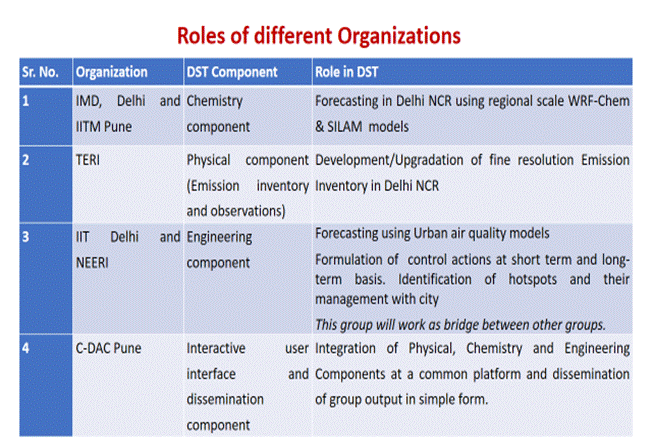
The Commission has entrusted the task to expert groups from reputed knowledge institutions of the country given below for framework development of Air Quality Management DSS for Delhi:-

 The Air Quality Management Decision Support Tool (DST) integrates an emissions inventory development application and database; regional, local, and source–receptor modelling; and Geographical Information System (GIS) based visualization tools in a software framework to build a robust system to formulate and implement source-specific interventions to improve the air quality over targeted sectors of Delhi / NCR. Identification of source-specific interventions by the DST is deliberated with the involvement of stakeholders.

The covered sources will include industries, transport, power plants, residential, DG sets, road dust, agricultural burning, refuse burning, construction dust, ammonia, volatile organic compounds, and landfills. For instance, municipalities, industrial associations, industrial development authorities, etc., would be the stakeholders in identifying interventions related to waste burning and industrial source pollution.

Upon identification of feasible interventions, the artificial intelligence-based expert system has a hierarchical database of simulated scenarios, potentially assessing the impact of the identified possible intervention, which would be implemented by regulatory organizations such as CPCB and state PCBs. The on-field implementation is monitored independently by credible citizen watch groups and professional NGOs. Finally, air quality data collected near the area where the intervention is implemented will be analyzed to understand the real-world benefits of such intervention. Source: Press Release Release ID: 1691200 Date: January 22, 2021 PIB Delhi Ministry of Environment, Forest and Climate Change

73rd Army Day celebrated


Image Courtesy: pib.gov.in

Indian Army celebrated its 73rd Army Day today. Every year, the Indian Army celebrates January 15 as ‘Army Day’ to commemorate the day when General (later Field Marshal) K M Carriappa took over the command of the Army from General Sir FRR Bucher, the last British Commander-in-Chief in 1949 and became the first Commander-in-Chief of Indian Army post Independence.

The celebrations commenced with a wreath-laying ceremony at the National War Memorial, where CDS Gen Bipin Rawat and the three Service Chiefs paid homage to the Martyrs.

General MM Naravane, Chief of the Army Staff, reviewed the Army Day Parade at the Cariappa Parade Ground, Delhi Cantonment and was awarded 15 Sena Medals (including five posthumously) for individual acts of Gallantry and 23 COAS Unit Citations for commendable performance of their respective units. The Army Day parade was commanded by Maj Gen Alok Kaker, Chief of Staff, Delhi Area. The leading contingent of the train was formed of the recipients of the Param Vir Chakra and Ashok Chakra awardees. This was followed by army contingents, which included T-90 tank BHISHMA, infantry combat vehicle BMP II, BRAHMOS missile system, PINAKA Multiple Launch Rocket System, upgraded SCHILKA Gun System, Bridge Layer Tank, international sports awardees, and seven marching contingents including mounted horse cavalry.

The Indian Army also conducted a live demonstration of Drone Swarming capability using 75 indigenously designed and developed drones that executed an array of Artificial Intelligence (AI) enabled simulated offensive missions and close support tasks.

Source: Press Release
Release ID: 1688778
Date: January 15, 2021
PIB Delhi
Ministry of Defence

Attorney General James Issues Warning About Scam Targeting Grandparents During Pandemic


  • “Grandparent Scam” Targets Seniors with Phone Calls from Fraudsters Posing as Grandchild Asking for Money
  • With Seniors More Isolated Than Ever Due to COVID-19 Restrictions,
  • AG James Offers New Yorkers Tips to Protect Themselves

NEW YORK – New York Attorney General Letitia James today issued an alert to New Yorkers, warning them about the “Grandparent Scam,” a common phone scam that targets senior citizens with calls from fraudsters posing as a grandchild of the victim and asking for money. Attorney General James also shared a public service announcement in which high school students explain how the scam works and tips on avoiding becoming a victim to grandparents. The report features television personality Dr. Ruth Westheimer, who shares her experience about almost falling victim to the scam.

“Due to COVID-19 restrictions, many grandparents have not seen their grandchildren for months and maybe especially susceptible to this common and despicable scam,” said Attorney General James. “I urge all New Yorkers to be on the alert for this type of fraud and to protect themselves and their family members by following these tips. We should all be speaking with elderly family members and warning them that scammers are ready to prey on their love of family in an effort to take their money.”

The scam typically works as follows: A senior receives an unexpected call from someone who claims to be their grandchild. The caller then falsely claims an emergency and asks the grandparent to send money immediately. For example, the caller might say, “Grandma, I got arrested for drunk driving. I need bail money fast.” Or the caller may claim to have been mugged or that their car has broken down. The caller will often explicitly tell the grandparent not to call the grandchild’s parents because they will be mad or worry too much. The caller may also pose as an attorney, a bail bondsperson, or a law enforcement official contacting the grandparent on behalf of a grandchild.

The scammers often call in the middle of the night or early in the morning to take advantage of the fact that the victim may not be alert enough to ask more questions. Victims are often instructed to mail cash payments or go out and buy prepaid debit or gift cards and call back and read the serial number on the cards, allowing the scammer to transfer the funds immediately. Victims often lose thousands of dollars, and the money is rarely recovered, as the scammers can call from anywhere in the world. The scam is severely underreported, as many victims are often embarrassed and do not want to tell anyone they fell for it.

Attorney General James offers the following tips to protect against the Grandparent Scam:

  • Take a pause. Scammers create a sense of urgency to prey on victims’ emotions and their love for family members.
  • Verify any supposed emergency by calling friends and family before sending money. It is essential if a potential victim has been warned not to do so.
  • A grandparent may think they would know whether they were speaking to their grandchild or an imposter, but it is easy to be fooled. The caller may be crying, the background may be noisy, or the caller may claim the connection is terrible.
  • If the caller purports to be a bail bonds person, ask where the relative is being held and directly contact the facility. Grandparents can also call their local police department, where officers can reach the jail and confirm the story.
  • Be suspicious of anyone who calls unexpectedly asking to be sent money.
  • Never send cash through the mail.
  • Never purchase prepaid debit cards or gift cards to transfer money.
  • Develop a secret code or “password” with family members that can be used to verify family members’ identities over the phone.
  • Ask a question to which only the real grandchild would know the answer, such as “What was the name of your first pet?”
  • Set Facebook and other social media settings to private to limit the information available to scammers, such as grandchildren’s names.

In 2020, the Federal Trade Commission received 24,545 complaints of individuals impersonating family members and friends, up from 20,234 in 2019. New Yorkers alone filed 1,359 complaints in 2020.

Source: Press Release
Date: January 6, 2021
Attorney General's Press Office/212-416-8060 
nyag.pressoffice@ag.ny.gov

Attorney General James Helps Secure $2.4 Million from Sabre After Data Breach


NEW YORK – New York Attorney General Letitia James announced a $2.4 million multistate agreement with Sabre Corporation that resolves an investigation into the 2017 data breach of Sabre Hospitality Solutions’ hotel booking system. The breach exposed the data of approximately 1.3 million credit cards. In addition to the $2.4 million payment — $111,783.19 of which will go to the state of New York — Sabre will be required to make numerous changes to its security and notification protocols.

“Companies need to do a better job of notifying New Yorkers when their personal information has been breached,” said Attorney General James. “Sabre first failed its customers with a susceptible security system, then failed them when it came to providing proper notifications. Today’s agreement not only imposes a hefty fine on Sabre but will ensure that the company has the appropriate security and incident response plan in place so that its failure does not take place again.”

Sabre Hospitality Solutions, a business segment of Sabre, operates the SynXis Central Reservation System, facilitating hotel reservation booking. SynXis connects business travel coordinators, travel agencies, and online travel booking companies on one end to Sabre’s hotel customers on the other. On June 6, 2017, Sabre informed its hotel clients of a data breach between August 2016 and March 2017, which the business had disclosed in a 10-Q filing with the U.S. Securities and Exchange Commission (SEC) the month before. The hotel clients notified the affected consumers, resulting in some statements being issued as late as 2018 and some consumers receiving multiple notifications stemming from the same breach.

Today’s agreement requires Sabre to include language in future contracts that specifies the roles and responsibilities of both parties in the event of a breach. It also requires Sabre to determine whether its clients have notified consumers and to provide the attorney general with a list of all the customers it has announced. Finally, the agreement requires Sabre to implement and maintain a comprehensive information security program, implement a written incident response and data breach notification plan, implement specific security requirements, and undergo a third-party security assessment.

Joining Attorney General James in announcing today’s agreement are the attorneys general of Alaska, Arizona, Arkansas, Connecticut, Florida, Hawaii, Illinois, Indiana, Iowa, Louisiana, Michigan, Minnesota, Missouri, Montana, Nebraska, Nevada, New Jersey, North Carolina, North Dakota, Ohio, Oregon, Pennsylvania, Tennessee, Vermont, Virginia, and Washington.

This matter was handled by Deputy Bureau Chief Clark Russell of the Bureau of Internet and Technology under the supervision of Bureau Chief Kim Berger. The Bureau of Internet and Technology is a part of the Division for Economic Justice, led by Chief Deputy Attorney General Chris D’Angelo and overseen by First Deputy Attorney General Jennifer Levy.

Source: Press Release
Date: December 23, 2020
Attorney General’s Press Office/212-416-8060 
nyag.pressoffice@ag.ny.gov

Attorney General James Leads Multistate Lawsuit Seeking to End Facebook’s Illegal Monopoly


  • AG James Leads Bipartisan Coalition of 48 Attorneys General Charging Anticompetitive Conduct
  • Facebook Thwarted Competition, Reduced Consumer Privacy for Profits

NEW YORK – New York Attorney General Letitia James filed a lawsuit against Facebook Inc. today, alleging that the company has and continues to stifle competition to protect its monopoly power illegally. The lawsuit alleges that, over the last decade, the social networking giant illegally acquired competitors in a predatory manner and cut services to more minor threats — depriving users of the benefits of competition and reducing privacy protections and services along the way — all to boost its bottom line through increased advertising revenue. Attorney General James leads a bipartisan coalition of 48 nationwide attorneys in filing today’s lawsuit to stop Facebook’s anticompetitive conduct.

“For nearly a decade, Facebook has used its dominance and monopoly power to crush smaller rivals and snuff out competition, all at the expense of everyday users,” said Attorney General James. “Today, we are taking action to stand up for the millions of consumers and many small businesses that have been harmed by Facebook’s illegal behaviour. Instead of competing on the merits, Facebook used its power to suppress competition so it could take advantage of users and make billions by converting personal data into a cash cow. Almost every state in this nation has joined this bipartisan lawsuit because Facebook’s efforts to dominate the market were as illegal as they were harmful. Today’s suit should send a clear message to Facebook and every other company that any efforts to stifle competition, reduce innovation, or cut privacy protections will be met with the full force of our offices.”

Since 2004, Facebook has operated as a personal social networking service that facilitates sharing content online without charging users a monetary fee but, instead, provides these services in exchange for a user’s time, attention, and personal data. Facebook then monetizes its business by selling advertising to firms that attach immense value to user engagement and highly targeted advertising that Facebook can deliver due to the vast trove of data it collects on users, their friends, and their interests.

To maintain its market dominance in social networking, Facebook employs various methods to impede competing services and — as Chairman, Chief Executive Officer, and controlling shareholder Mark Zuckerberg has stated — to “build a competitive moat” around the company. The two most utilized strategies have been to acquire smaller rivals and potential rivals before they could threaten Facebook’s dominance and suffocate and squash third-party developers that Facebook invited to use its platform — allowing Facebook to maintain its monopoly over the social networking market and make billions from advertising. As one market participant noted, if an application (app) encroached on Facebook’s turf or didn’t consider selling, Zuckerberg would go into “destroy mode,” subjecting small businesses to the “wrath of Mark.”

Consumers Suffer – Reduced Privacy and Fewer Options

Facebook’s unlawful monopoly gives it broad discretion to set the terms for how its users’ private information is collected and used to further its business interests. When Facebook cuts off integration to third-party developers, users cannot quickly move their information to other social networking services, such as their friends’ lists. This decision forces users to stay put or start their online lives from scratch if they want to try an alternative.

Because Facebook users have nowhere else to go, the company can now decide how to curate content on the platform and use the personal information it collects to further its business interests, even if those choices conflict with the goods and preferences of Facebook users.

Additionally, while consumers initially turned to Facebook and other apps now owned by the company seeking privacy protection and control over their data — Facebook’s “secret sauce” — many of those protections are now gone.

Who Would Turn Down a “High Enough Price”?

The harm to consumers over the last decade comes directly from Facebook’s acquisition of smaller firms that pose competitive threats. Facebook employs unique data-gathering tools to monitor new apps to see what is gaining traction with users. That data helps Facebook select acquisition targets that pose the greatest threats to Facebook’s dominance. Once selected, Zuckerberg and Facebook offer the heads of these companies vast amounts of money — that significantly inflates the values of the apps — all in hopes of avoiding any competition for Facebook in the future.

When it came to startups, Zuckerberg has observed that if these companies were not inclined to sell, “they’d have to consider it” if Facebook offered a “high enough price.”

The elimination of competitive alternatives means users have no option to Facebook, fueling its unfettered growth without competition and further entrenching its position. Instagram and WhatsApp were the two most prominent examples of this successful strategy, which posed a unique and dire threat to Facebook’s monopoly.

#TotalDomination – Purchase of Instagram

Facebook and Zuckerberg quickly saw Instagram as a direct threat after the company launched. After initially trying to build its version of Instagram that gained no traction, Zuckerberg admitted in early 2012 that Facebook was “very behind” Instagram and that a better strategy would be “to consider paying a lot of money” for the photo-sharing app to “neutralize a potential competitor.”

A few months later, in April 2012, Facebook acquired Instagram for $1 billion, despite not having a single cent of revenue and valuing itself at only $500 million. Zuckerberg offered Instagram’s owners double the valuation that Instagram came up with, even though Zuckerberg previously described the initial $500 million value as “crazy.”

$100 Million Isn’t Cool. You Know What’s Cool?…$19 Billion – Purchase of WhatsApp

The mobile messaging app WhatsApp also posed a unique threat to Facebook’s growth, allowing users to send messages on their mobile devices one-to-one and to groups. While Facebook focused on several emerging mobile messaging services, WhatsApp was viewed as the “category leader”, with over 400 million active users worldwide in 2014, and the one that could potentially pose the most significant threat.

Facebook feared WhatsApp eroding its monopoly power, stating WhatsApp or similar products posed “the biggest competitive threat we face as a business.” Facebook was also concerned that WhatsApp could ultimately be bought by a competing behemoth that had previously shown interest in social networking — Google.

In February 2014, Facebook acquired WhatsApp for nearly $19 billion — wildly more than the extravagant price Zuckerberg had recommended paying a few months earlier and the $100 million another competitor offered to buy the company two years earlier.

Here Today, Gone Tomorrow – Cutting Competitors Off from Facebook Overnight

As laid out in today’s complaint, Facebook targets competitors with a ‘buy or bury’ approach: if they refuse to be bought out, Facebook tries to squeeze every bit of oxygen out of the room for these companies. To facilitate this goal, Facebook has used an “open first–closed later” strategy to stop or deter competitive threats from competing at the inception.

Facebook opened its platform to apps created by third-party developers to increase functionality on the site and, subsequently, increase the number of users on Facebook. Facebook also drove traffic to third-party sites by making it easier for users to sign in so that Facebook could capture valuable data about its users’ off-Facebook activity and enhance its ability to target advertising.

Not only did Facebook benefit monetarily through the third-party developers’ revenue, but Facebook’s services were expanded, as Facebook could not create and develop all the useful social features offered through third-party developers.

After years of promoting open access to its platform, in 2011, Facebook began to rescind and block access to the site to apps that Facebook viewed as actual or potential competitive threats. Facebook understands that an abrupt termination of established access to the site can be devastating to an app — especially one still relatively new to the market. An app that suddenly loses access to Facebook is hurt not only because its users can no longer bring their friend lists to the new app but also because a sudden loss of functionality — which creates broken or buggy features — suggests to users that an app is unstable. In the past, some of these companies experienced almost overnight drop-off in user engagement and downloads, and their growth stalled.

Facebook’s response to competitors also warns other apps that if they encroach on Facebook’s territory, Facebook will end their access to crucial integrations. Additionally, Facebook’s actions deter venture capitalists from investing in companies that Facebook might see as competitors in the future.

Ads Aren’t Cool…But They Are Profitable

Due to Facebook’s expansive user base and the vast trove of data it collects from its users and users’ connections, Facebook can sell highly targeted advertising that firms greatly value.

The volume, velocity, and variety of Facebook’s user data give it an unprecedented, virtually 360-degree view of users and their contacts, interests, preferences, and activities. The more users Facebook can acquire and convince to spend additional time on its platforms, the more data Facebook can accumulate by surveilling the activities of its users and thereby increasing its revenues through advertising — reaping the company billions every month.

Specific Violations

Facebook is specifically charged with violating Section 2 of the Sherman Act and multiple violations of Section 7 of the Clayton Act.

Remedies

Attorney General James and the coalition asked the court to halt Facebook’s illegal, anticompetitive conduct and block the company from continuing this behaviour. Additionally, the team asks the court to restrain Facebook from making further acquisitions valued at or more than $10 million without advance notice to the state of New York and other plaintiff states. Finally, the court is asked to provide any additional relief it determines is appropriate, including the divestiture or restructuring of illegally acquired companies or current Facebook assets or business lines.

The complaint was filed in the U.S. District Court for the District of Columbia.

Separately, but in coordination with the coalition led by Attorney General James, the Federal Trade Commission (FTC) filed a complaint against Facebook in the U.S. District Court for the District of Columbia today. Attorney General James wishes to thank the FTC for its close working relationship and collaboration during this investigation.

Attorney General James leads this lawsuit with an executive committee comprised of the attorneys general of California, Colorado, Florida, Iowa, Nebraska, North Carolina, Ohio, Tennessee, and the District of Columbia. The executive committee is joined by the attorneys general of Alaska, Arizona, Arkansas, Connecticut, Delaware, Hawaii, Idaho, Illinois, Indiana, Kansas, Kentucky, Louisiana, Maine, Maryland, Massachusetts, Michigan, Minnesota, Mississippi, Missouri, Montana, Nevada, New Hampshire, New Jersey, New Mexico, North Dakota, Oklahoma, Oregon, Pennsylvania, Rhode Island, Texas, Utah, Vermont, Virginia, Washington, West Virginia, Wisconsin, Wyoming, and the territory of Guam.

The Facebook investigation is being handled by Assistant Attorneys General Johanna Skrzypczyk, Hanna Baek, and Nathaniel Kosslyn, Legal Assistant Shirly Huang, and Internet and Technology Analyst Joe Graham — all of the Bureau of Internet and Technology, under the supervision of Bureau Chief Kim Berger; Assistant Attorneys General Zach Biesanz, Beatriz Marques, James Yoon, and Amber Wessels-Yen, and Legal Assistant Arlene Leventhal — all of the Antitrust Bureau, under the supervision of Bureau Chief Elinor Hoffmann; Chief Economist Paola Valenti; and Project Attorney Benjamin Cole. The Bureau of Internet and Technology and the Antitrust Bureau are part of the Division for Economic Justice, which Chief Deputy Attorney General Chris D’Angelo and First Deputy Attorney General Jennifer Levy oversee.

Source: Press Release
December 9, 2020
Attorney General’s Press Office/212-416-8060 
nyag.pressoffice@ag.ny.gov