What
A research team funded by the National Institutes of Health has launched a study to assess the performance and usability of a smartphone app paired with the Quidel QuickVue At-Home COVID-19 Test, which just received an Emergency Use Authorization (EUA) from the U.S. Food and Drug Administration for use with a prescription. The home test was supported by NIH through the Rapid Acceleration of Diagnostics (RADx) initiative, which has spurred the development and commercial availability of millions of COVID-19 tests over the past year.
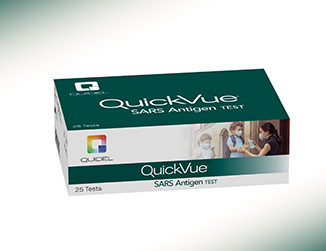
Quidel QuickVue At-Home COVID-19 Test. Quidel photo
More than 200 participants have already enrolled in the study, which involves two-week daily testing. An app called MyDataHelps, developed by CareEvolution, LLC, provides step-by-step instructions for taking the test and essential tools such as timers to ensure that the steps are performed at the correct time intervals. Although users can interpret the test result independently, the app also provides independent confirmation when the user photographs the test strip with the smartphone camera.
Understanding how individuals interact with these apps and where they find value in them will inform future efforts to advance at-home COVID-19 testing.
The antigen test gives results in just 10 minutes using a nasal swab sample placed in a test tube, followed by adding a test strip. The visually read, coloured lines on the test strip indicate a positive or negative result—similar to a pregnancy test.
As rapid, at-home COVID-19 tests like QuickVue become more widely available, companion smartphone apps are expected to play an essential role in their successful use. Apps offer great potential to assist individuals with administering tests, tracking symptoms, and interpreting results – ultimately resulting in improved test performance and ease of use. In addition to providing valuable guidance, apps can also make it straightforward to report results to public health authorities and healthcare providers.
The National Institute for Biomedical Imaging and Bioengineering (NIBIB), which is part of the NIH, supports these technologies. Quidel intends to apply for an additional EUA from the FDA to sell this test over the counter without a prescription.
Who
Bruce J. Tromberg, Ph.D., director of NIBIB and lead for the RADx Tech program, can comment on COVID-19 testing technology.
About the Rapid Acceleration of Diagnostics (RADx) initiative: The RADxSM initiative was launched on April 29, 2020, to speed innovation in the development, commercialization, and implementation of technologies for COVID-19 testing. The initiative has four programs: RADx Tech, RADx Advanced Technology Platforms, RADx Underserved Populations, and RADx Radical. It leverages the existing NIH Point-of-Care Technology Research Network. The RADx initiative partners with federal agencies, including the Office of the Assistant Secretary of Health, the Department of Defense, the Biomedical Advanced Research and Development Authority, and the U.S. Food and Drug Administration.
About the National Institute of Biomedical Imaging and Bioengineering (NIBIB): NIBIB’s mission is to improve health by leading the development and accelerating the application of biomedical technologies. The Institute is committed to integrating the physical and engineering sciences with the life sciences to advance basic research and medical care. NIBIB supports emerging technology research and development within its internal laboratories through grants, collaborations, and training.
About the National Institutes of Health (NIH): NIH, the nation’s medical research agency, includes 27 Institutes and Centers and is a component of the U.S. Department of Health and Human Services. NIH is the primary federal agency conducting and supporting basic, clinical, and translational medical research investigating the causes, treatments, and cures for common and rare diseases.
Source: Press Releases
Date: March 1, 2021
nibib.nih.gov

 Ananova
You must be logged in to post a comment.