IISF-2020
‘Agricultural Scientists’ Meet’ is a significant India International Science Festival 2020 event. It provides a common platform for agricultural scientists, innovative farmers, teachers, and students to actively participate and discuss various emergent topics such as Synergism and tradeoffs in sustainable agriculture, NRM— challenges and policy framework, Precision farming technologies & agricultural production systems, Data-driven technologies in agriculture and their management, and Innovation and agriculture. The event aims to cater to the need to reduce the impact of weather vagaries on agriculture and make agriculture a reliable income-earning pursuit for marginal stakeholders.
Union Minister of State for Agriculture and Farmers’ Welfare, Government of India, Shri Kailash Choudhary, inaugurated the two-day Agricultural Scientists’ Meet as part of India International Science Festival 2020. Other dignitaries on the occasion were Prof. Ramesh Chand, Member, NITI Aayog; Dr. T. Mohapatra, Secretary (DARE) and DG, ICAR. Around 200 participants, including scientists, students and farmers, attended the programme.



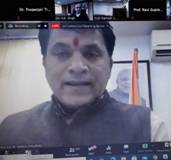

The chief guest, MoS for Agriculture and Farmer Welfare Shri Kailash Choudhury Prof. Ramesh Chand, member NITI Ayog
At the outset, Dr. A. K. Singh, DDG (Agricultural Extension), ICAR, welcomed the dignitaries and briefed them about the Agricultural Scientists’ Meet. Dr. Trilochan Mohapatra, DG, ICAR, in his address, talked about the journey of the agriculture sector in India from the pre-green revolution to the present status and stressed the need for technologies for sustainable agricultural development.
Chief Guest Prof. Ramesh Chand talked about food and nutritional security. He further explained that science, Innovation, and policy support can increase farmers’ income. Dr. K. K. Singh of the India Meteorological Department proposed the vote of thanks.
In the session titled “Synergism and Tradeoffs in Sustainable Agriculture” of the Agriculture Scientist Meet, more than 200 participants attended the session.
The session’s Chairman, Padam Bhushan Dr. R.B Singh, Ex-Chancellor, CAU, Imphal, praised the organizers for hosting the event. He cautioned that the resources are not inherited from our parents, but we borrow them from our children. He emphasized the need for extensive data analysis and artificial intelligence for a decision support system. He pointed out that agriculture significantly impacts all pillars of our structure– environmental, economic, and social sustainability. He focused on sustainable agriculture for zero hunger and a poverty-free nation.
Prof. Kamal Vatta stated that there is a need to look for sustainable agriculture, which can be achieved by integrating ecological, economic, environmental, and social aspects. Synergies are achievable at a lower scale, but when the scale increases, it becomes difficult to maintain the synergy in the system, so scale is significant. He expressed that despite research support and evidence of no productivity loss, farmers are reluctant to adopt sustainable agricultural practices only because of a lack of economic incentives. He expressed his desire that financial incentives be given to farmers for the adoption of sustainable technologies.
Dr Suresh Pal informed us that the performance of the agriculture sector has improved significantly in the last few years. He emphasized the need to double the export of our agriculture commodities by 2025 as we have grown 3.5-4% for the previous few years. He also focused on producing oil-seed crops and other crops we import. This will help to reduce our import bill, he said.
Mr. Rajpal Rathore, a farmer activist from Madya Pradesh, highlighted that sustainability is directly related to doubling farmers’ incomes. He stressed that along with nutritional security, chemical-free food production is also an essential factor for a healthy world.
Dr Anupam Mishra focused on sustainable agriculture in different regions of the country and stated that the meaning of sustainable agriculture in the hilly, coastal, arid, and semiarid areas is extra. He highlighted various schemes of the Indian Government for agriculture and rural development, especially for the remote areas.
The second session focused on ‘Challenges and Policy Framework’. Dr AK Singh, Ex-Vice Chancellor, Agriculture University, Gwalior and Ex-DDG, and Secretary NAAS appreciated the organizers highlighting the Natural Resource Management (NRM) under Agriculture Scientist Meet. They extensively discussed the foremost issues in the country related to sustainable agriculture, like groundwater extraction, water quality, soil health management, and climate change. He also concentrated on the soil health management approach and advised the scientific community to encourage farmers to use fertilizer in a balanced manner.
Dr. O.P. Choudhary, Head, Department of Soil Science, PAU, Ludhiana, discussed the ongoing practices adopted by the farmers in Punjab and advised the farmers to accept the Innovation and technologies for higher yield and farm resource management.
Dr Man Singh, PD, WTC, IARI, outlined the long-term vision of sustainable agriculture, keeping water at its centre. He explained the role of water, soil, and energy in the agro-ecosystem. Dr Singh concentrated on near-future water conservation through water harvesting and groundwater recharging in the changing climate. For this focused research and development, helpful knowledge requires an authenticated primary dataset. He said this information will help the community make decisions in climate change scenarios. One of the progressive farmers from Punjab, Sh. Jagtar Singh Brar, Bathinda, also shared his views and experience on soil degradation and exploitation issues due to intensive agriculture, soil health management, carbon credit awareness, and the use of organic carbon instead of chemical fertilizer.
Dr V.K Singh, Head of Agronomy, IARI, highlighted the repeated cropping pattern approach of Indian Agriculture. “This kind of cropping system exploits the natural resources and threatens the state of soil health day by day”, he pointed out. Therefore, he suggested shifting towards crop diversification. The inclusion of short-duration crops can save resources and help reduce soil degradation.
Energy Conclave
There is a Need to Accelerate Technological Innovation to Deliver Eco-friendly and Cost-Effective Energy Technologies: Shri Raj Kumar Singh, Union State Minister (Power, New & Renewable Energy)
“Energy Conclave” focused on clean energy for Self-reliance and Global welfare and was inaugurated by Shri Raj Kumar Singh, Union Minister of State (I/C), Ministry of Power & Ministry of New and Renewable Energy. The Minister appreciated efforts being made in making India a trailblazer in the Energy sector with a focus on “Energy Access”, “Energy Sufficiency”, and “Energy Transition”, paving the way towards a vibrant “Energy Economy” for a Sustainable future ahead, making renewable energy cheaper and affordable to all. He reiterated that by 2030, 40% of our established capacity will come from non-fossil fuel. The Minister emphasized the need to accelerate and strengthen technological Innovation so that it can deliver environmentally and socially sound, cost-effective energy technologies on a larger and more widespread scale.
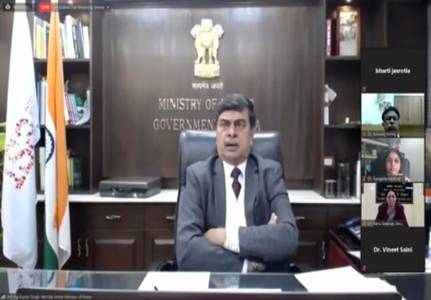
Shri Raj Kumar Singh, Union State Minister (Power, New & Renewable Energy), addressing the Energy Conclave at IISF 2020
Dr. Renu Swarup, Secretary, Department of Biotechnology, Govt. of India, emphasized that the Innovation Partnership for a Sustainable Future underpins India’s mutual commitment to drive prosperity and address global challenges and sustainable development through cooperation in science, technology, and Innovation. Dr. Sangita Kasture, a Scientist with DBT, discussed the various initiatives being carried out in the clean energy landscape via Collaborative R&D, Startup support via the Clean Energy International Incubation Centre, Breakthrough Clean technologies, Innovative Waste to Energy, Energy Efficiency and Energy Access areas, and accelerating clean energy Innovations under Mission Innovation platform.
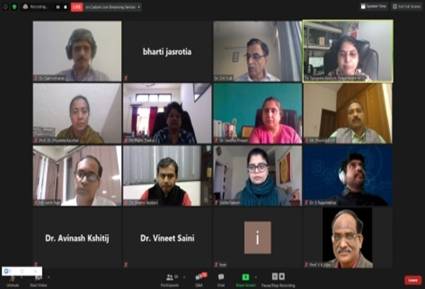
The Webinar via Virtual session focused on Showcasing Clean Energy technologies by engaging Stakeholders from the Govt. sector, Research, Academia, Industry, startups, and incubators (CEIIC). The key clean energy areas/themes covered during the session included renewable energy generation, energy conservation/energy reduction in the built environment, and cross-sectoral technologies and innovations.
Press Information Bureau
Government of India
Ministry of Science & Technology
Date: December 25, 2020

 Ananova
You must be logged in to post a comment.