India is fast emerging as a leader in high-power computing, with the National Super Computing Mission (NSM) boosting it to meet the increased computational demands of academia, researchers, MSMEs, and startups in areas like oil exploration, flood prediction, genomics, and drug discovery.
Computing infrastructure has already been installed in four premier institutions, and installation work is in progress in 9 more. Completing Phase II of NSM in September 2021 will take the country’s computing power to 16 Petaflops (PF). MoUs have been signed with 14 premier institutions of India for establishing Supercomputing Infrastructure with Assembly and Manufacturing in India. These include IITs, NITs, National Labs, and IISERs.
Infrastructure planned in NSM Phase I has already been installed, and much of Phase II will be in place soon. Phase III, initiated this year, will take the computing speed to around 45 Petaflops. This will include three systems of 3 PF each and one system of 20PF as a national facility.
The National Supercomputing Mission was launched to enhance the research capacities and capabilities in the country by connecting them to form a Supercomputing grid, with the National Knowledge Network (NKN) as the backbone. The NSM is setting up a grid of nationwide supercomputing facilities in academic and research institutions. Part of this is being imported from abroad and partly built indigenously. The Mission is being jointly steered by the Department of Science and Technology (DST) and the Ministry of Electronics and Information Technology (MeitY) and implemented by the Centre for Development of Advanced Computing (C-DAC), Pune, and the Indian Institute of Science (IISc), Bengaluru.
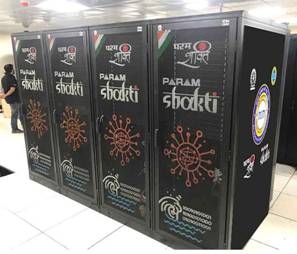
PARAM Shivay, the first supercomputer assembled indigenously, was installed in IIT (BHU), followed by PARAM Shakti, PARAM Brahma, PARAM Yukti, PARAM Sanganak at IIT-Kharagpur IISER, Pune, JNCASR, Bengaluru, and IIT Kanpur respectively.
A new dimension has been added to India’s march towards a leadership position in supercomputing with the convergence of HPC and Artificial Intelligence (AI). A 200 AI PF Artificial Intelligence supercomputing system has been created and installed in C-DAC, which can handle incredibly large-scale AI workloads, increasing the speed of computing related to AI several times. PARAM Siddhi – AI, the high-performance computing-artificial intelligence (HPC-AI) supercomputer, has achieved a global ranking of 62 in the world’s TOP 500 most potent supercomputer systems, released on November 16 2020.
The Mission has also created the next generation of supercomputer experts by training more than 4500 HPC-aware manpower and faculties. To expand the activities of the HPC training, four NSM Nodal Centres for training in HPC and AI have been established at IIT Kharagpur, IIT Madras, IIT Goa, and IIT Palakkad. These centres have conducted online training programs in HPC and AI.
Powered by the NSM, India’s network of research institutions, in collaboration with the industry, is scaling up its technology and manufacturing capabilities to make more and more parts in India. While in Phase I, 30 per cent value addition is done in India, scaled up to 40 per cent in Phase II. India has developed an Indigenous server (Rudra), which can meet the HPC requirements of all governments and PSUs.
The three phases will provide access to High-Performance Computing (HPC) Facilities to around 75 institutions and thousands of active researchers and academicians working through the Nation Knowledge Network (NKN) – the backbone for supercomputing systems.
Source: Press Release
Release ID: 1709875
PIB
Ministry of Science & Technology
Date: April 06, 2021

 Ananova
You must be logged in to post a comment.